Volume pricing sounds simple until you try to actually compare quotes. Here's how per-cubic-foot pricing really works in Montreal, what drives the number up or down, and how it stacks up against bin rental and DIY.
Describe your volume and we'll give you a price range on the phone - no blind estimate required.
Call now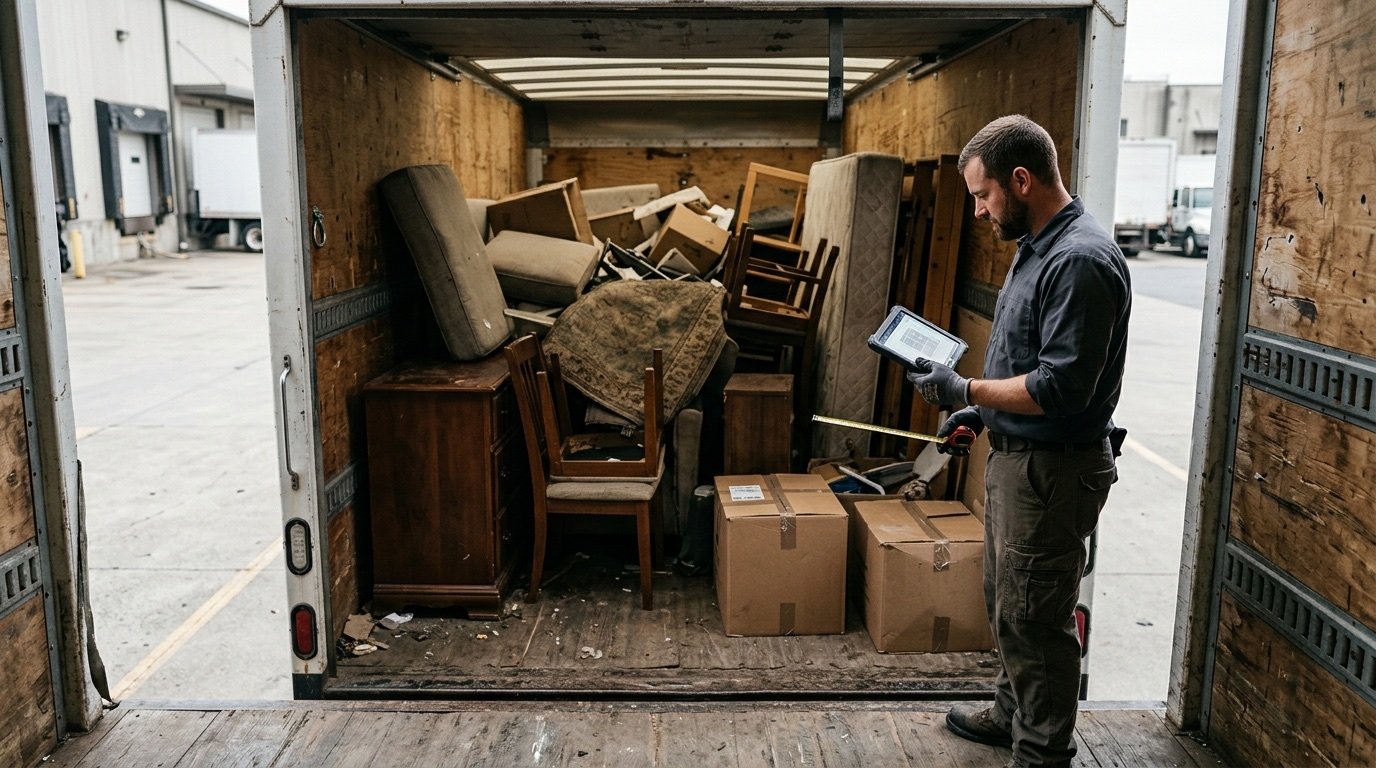
Quick answer: in Montreal, junk removal is priced by volume in cubic feet (cu ft) or cubic metres (m³): 1 m³ = 35.3 cu ft. At Good Bye Junk, a full load of 800 to 1,000 cu ft (23 to 28 m³) costs $800 to $1,200, roughly $35 to $42 per m³. A few items work out to about $105 per m³. Figures checked October 3, 2026.
Search for junk removal pricing in Montreal and you'll eventually run into some version of "per cubic foot" or "per cubic yard" pricing language. It sounds precise - like a hardware store selling gravel by the bag - but in practice, almost no junk removal company in Montreal (including us) prices strictly by a single per-cubic-foot rate. What actually happens is closer to volume-tiered pricing: your items are estimated as a fraction of a standard truck load (a few items, a quarter load, a half load, a full load), and the price is set for that tier rather than calculated item-by-item with a per-unit rate.
That said, understanding the volume logic behind these tiers is genuinely useful, because it lets you sanity-check a quote and compare providers on an apples-to-apples basis instead of just picking whoever answers the phone first. This guide breaks down how volume actually translates to price, what pushes a quote higher even at the same volume, and how it compares to the alternatives - a rented bin, a DIY ecocentre run, or simply leaving it for the next municipal collection.
A standard junk removal truck holds a fixed cargo volume - think in terms of a large box truck, typically somewhere in the range of 500-800 cubic feet depending on the vehicle. When you call for a quote, an experienced estimator is essentially trying to answer one question: what fraction of that box will your items fill? A couple of chairs and a side table might be an eighth of the truck. A cleared-out basement might be half. A full apartment's worth of furniture could fill the whole thing.
| Volume | Real-world example | Good Bye Junk price range |
|---|---|---|
| A few items | 2-3 pieces of furniture, one appliance | $150 – $300 |
| 1/4 to 1/2 truckload | Basement, garage, one full room | $400 – $700 |
| Full truckload | Complete home cleanout, estate, small commercial space | $800 – $1,500+ |
Indicative pricing for Montreal, Laval and the South Shore, confirmed based on real access and actual on-site volume.
Two loads that look identical in size on paper can come in at different prices, and it's not because one company is padding the bill. A handful of factors shift the real cost even when the cubic footage stays constant:
A truck fills up on weight before it fills up on space when the material is dense - concrete, soil, tile, stacks of books, filing cabinets. These items can cost more per cubic foot than lightweight bulky furniture that takes up the same visual space.
A 30th-floor condo with a booked elevator window takes longer to load than a ground-floor unit with a driveway, even at the identical volume - see our condo access guide for the full picture.
Certain materials (appliances with refrigerant, some construction debris) carry their own disposal fees at the receiving facility, which factors into the final price independent of pure volume.
Items that need disassembly, careful handling, or extra crew members to move safely add time to the job beyond what raw cubic footage would suggest.
A rented bin looks cheaper on the surface - you see one flat delivery/pickup fee and assume that's the whole cost. The real comparison needs to include everything else the bin doesn't cover: you still have to move every single item from inside your home to the bin yourself, which for a full basement or a multi-room cleanout means hours of physical labor most people underestimate. Bins also typically charge extra if you exceed the weight allowance included in the base rental, and disposal-facility tipping fees are usually on top of the rental price, not included in it.
Bins make more sense for situations where the volume is genuinely large and spread out over time - an ongoing renovation where debris accumulates over several weeks, for example, where you want a container sitting on-site rather than scheduling multiple pickups. For a one-time cleanout where the work needs to get done in a single visit, a junk removal service that does the carrying, loading and sorting usually ends up more cost-effective once your own labor time is factored in.
| Factor | Bin rental | Junk removal service |
|---|---|---|
| Base cost | Flat rental fee (delivery + pickup) | Volume-based price range |
| Loading labor | You do it yourself | Included - crew loads everything |
| Weight overage fees | Often charged separately | Factored into quote upfront |
| Sorting/donation | Not included | Included as part of our process |
| Best for | Ongoing multi-week projects | One-time cleanouts, tight timelines |
Doing it yourself is genuinely the cheapest option on paper for a small volume - a couple of trips to your local ecocentre with a vehicle you already own costs essentially nothing beyond your time and gas. Where the math shifts is volume and vehicle access. A full truckload's worth of furniture doesn't fit in a hatchback, which means either renting a truck, making many small trips, or recruiting help to carry heavy items - all of which have real costs even if they don't show up on an invoice.
There's also the sorting question. An ecocentre run means you've already sorted everything yourself before you arrive, and some materials get refused if they don't meet the facility's specific criteria. A junk removal service handles that sorting as part of the job, which matters more the larger and more mixed your volume gets. For a single item or two, DIY usually wins. For anything approaching a quarter truckload or more, the time and hassle math starts favoring a professional pickup.
Municipal bulky item collection is free, which makes it hard to beat on pure cost for a small volume with no time pressure. The tradeoff is entirely about scheduling - most Montreal boroughs and Laval sectors run this collection roughly once a month, so if your timeline doesn't line up with the next scheduled date, waiting isn't really free once you count the cost of storing items, the risk of a fine for early curbside placement, or a delayed home sale or move-out. Our guide to bulky waste bylaws in Montreal and Laval covers the scheduling details and fine risk in more depth.
One of the more frustrating parts of shopping around for junk removal in Montreal is that most companies simply don't publish price ranges anywhere. National franchise operations like 1-800-GOT-JUNK typically require you to request an in-person or virtual estimate before getting any number at all, and local competitors tend to offer similarly thin pricing information on their sites, leaving you to call around blind before you have any sense of what a fair price actually looks like.
We publish our volume-based price ranges directly on our site because we think you should be able to sanity-check a quote before you ever pick up the phone. It's not a guarantee that every job costs exactly what the table says - access, weight and material type still shift the final number, as covered above - but it gives you a real starting point instead of a black box. If you're comparing multiple quotes, ask each company what volume and access assumptions their number is based on; that's usually where the real difference between two quotes actually comes from.
To be fair to the alternative, a national franchise's in-person estimate process does have one advantage: an estimator physically looking at your items before quoting removes a lot of the guesswork on unusual volumes. The tradeoff is time - scheduling that visit, waiting for the estimator, then waiting again for the actual pickup date adds days to a process that a phone-based volume range can often skip entirely for a straightforward job.
2-3 pieces of furniture or one large appliance - roughly an eighth of a truckload.
A cleared basement, garage, or single fully-furnished room.
A complete home cleanout, estate, or small commercial space cleared entirely.
Describing your situation in these rough terms on the phone - "about a quarter of a room" versus "the whole basement" - gets you a much more accurate price range up front than trying to guess an exact cubic footage number yourself.
A pile of drywall, tile and old cabinetry from a kitchen or bathroom gutting looks modest in volume compared to a room full of furniture, but it's often far heavier - dense material that hits weight thresholds before it fills the visual space in the truck. Our renovation debris weight and cost guide breaks down real numbers for exactly this scenario, since volume alone underestimates the true cost of this kind of material.
A small business clearing out old fixtures, electronics, furniture and packaging material ends up with a load that's genuinely mixed in density and disposal category, which makes a flat per-cubic-foot estimate less useful than a walk-through quote. Our commercial waste management guide for small businesses covers how we price these more variable jobs.
Volume and access are the main drivers, but timing plays a smaller supporting role. Booking during peak periods - Quebec's July 1st moving season, the weeks right before a common home-sale closing period, or the last weekend before a major holiday - can mean less flexibility on scheduling, though our published price ranges by volume stay consistent regardless of season. If your timeline has flexibility, booking a few days out rather than requesting same-day service during a citywide busy stretch is more about availability than about getting a materially different price.
A vague number without a volume reference isn't comparable to another company's quote - ask for the assumption behind it.
Some quotes cover pickup only, with sorting or disposal fees added separately later.
Ask whether the phone estimate is binding or just a starting point that could shift once the crew arrives.
Appliances, mattresses and certain materials sometimes carry separate fees - confirm this is already factored in.
We give you a real price range on the phone based on the volume you describe, confirm it once we see the actual items and access on site, and don't add surprise line items after the fact. That's the whole philosophy behind publishing our pricing table in the first place - a customer comparing us against a competitor's blind quote request should be able to see roughly where we land before ever picking up the phone. Whether it's a residential cleanout, a commercial job, or a construction site, the same volume-based logic applies, adjusted for the material and access specifics of your situation.
The underlying volume-based logic stays the same across our whole service area, but a couple of regional factors can shift the final number slightly. Downtown and central Montreal addresses with tight parking or condo elevator restrictions add access time, as covered in our condo access guide. Laval and off-island South Shore addresses - Candiac, LeMoyne, Blainville and similar sectors - sometimes involve a longer drive to the nearest sorting or disposal facility, though this is generally a minor factor compared to volume and access, not a major line item on its own.
In practice, the same price table applies across our full coverage area - Montreal, Laval, the North Shore and the South Shore - with the final number confirmed on-site based on real volume rather than a different base rate depending on which side of the river you're on. See our full list of service areas for the neighbourhoods and cities we cover.
When someone tells us "I could just do it myself for free," we don't disagree that it's technically possible - we just point out what usually gets left out of that math. Renting a truck or van for a day runs a real cost even before you've disposed of a single item. Gas for multiple ecocentre trips adds up, especially if your closest facility isn't nearby. And the biggest hidden cost is almost always time: a full day spent loading, driving, unloading and repeating, versus a couple of hours with a crew that does the loading and hauling for you.
There's also a physical cost that's easy to discount until it happens - a strained back from lifting a mattress or a heavy dresser alone is a genuinely common way DIY cleanouts go wrong. None of this means DIY is a bad choice for a small volume; it just means the "free" comparison isn't quite as free as it looks once you count everything that goes into it, which is worth factoring in honestly when you're deciding between a $150 pickup and a "free" afternoon that turns into a full weekend project.
It's worth being explicit about what a volume-based junk removal price actually covers, since it's easy to compare it unfavorably to a bare-bones bin rental without accounting for everything bundled in. Our price ranges include the labor to carry items out of your home (stairs, elevators, tight hallways included), loading the truck, sorting materials by category once loaded, routing donatable items to the right channel, and final disposal of what can't be reused or recycled. A bin rental gets you a container and nothing else - every other step in that list is still on you.
Carrying, loading, sorting, donation routing, recycling, final disposal - one visit, no separate steps for you to manage.
A container on your property. Loading, sorting and hauling to a facility remain entirely your responsibility.
Bring it back to the basics: ask what volume tier the price is based on, confirm whether labor and sorting are included, check if the number is binding or subject to change on site, and find out whether any special-item disposal fees are already factored in. A quote that answers all four questions clearly is worth more than a lower number with no detail behind it - the lower number often turns into a higher final bill once the crew actually shows up and finds a fact that wasn't accounted for over the phone.
We built our pricing table specifically so that comparison is possible before you even pick up the phone. If your volume falls somewhere between two tiers, or your situation involves a mix of dense material and difficult access, the fastest way to get an accurate number is still a quick call - we'd rather ask a couple of clarifying questions upfront than surprise you with a different price once we're standing in your driveway.
Most companies estimate volume as a fraction of a full truckload rather than a strict per-cubic-foot rate, since weight, item type and access all affect the real cost.
For small to medium volumes, often comparable or cheaper once bin rental fees, weight overages and your own loading labor are factored in. Large multi-week projects can favor a bin.
Differences usually come down to what's included (labor, sorting, disposal fees) and whether pricing is transparent upfront or estimated on arrival.
Yes, in some cases - dense material like concrete or full filing cabinets can hit weight limits before volume limits, affecting price separately from the space used.
For a few small items, often yes. For larger volumes, multiple trips, a rented vehicle and your own labor often close the cost gap with a professional service.
Because most Montreal junk removal companies don't publish pricing at all - we publish real ranges by volume so you know what to expect before calling.
Three options, three different units (cubic feet, cubic yards, cubic metres). Here is everything converted to cubic metres. Junk removal prices come from our published grid and dumpster prices from our bin rental grid; in both cases the final number is confirmed against the real volume and access.
| Load | Volume | Price | Price per m³ (calculated) |
|---|---|---|---|
| A few items | 50-100 cu ft (1.4-2.8 m³) | $150 - $300 | about $105 |
| 1/4 load | 250-350 cu ft (7-10 m³) | $400 - $550 | about $55 - $60 |
| 1/2 load | 500-600 cu ft (14-17 m³) | $550 - $700 | about $40 |
| Full load | 800-1,000 cu ft (23-28 m³) | $800 - $1,200 | about $35 - $42 |
| Extra-large load | 1,000+ cu ft (28+ m³) | $1,200 - $1,500+ | about $40 - $55 |
Conversion: 1 m³ = 35.3 cu ft; 1 cubic yard = 27 cu ft = 0.76 m³. Price per m³ is the price divided by the volume, rounded. Indicative rates for Montreal, Laval and the Shores, October 2026.
| Factor | Junk removal crew | Dumpster (10-20 yard) | City bulky pickup |
|---|---|---|---|
| Price | $150 - $1,500+ by volume | $350 - $450 (10 yd), $450 - $600 (14 yd), $600 - $800 (20 yd) | Covered by property taxes |
| Volume | 1.4 to 28+ m³ | 7.6, 10.7 or 15.3 m³ | 2 to 5 m³ per address depending on borough |
| Price per m³ | about $35 - $105 (drops with volume) | about $39 - $59, loading not included | $0, but capped |
| Loading and carrying | Included, stairs too | You do it | You do it, items set at the curb |
| Lead time | 24-48h, rush available | Fast delivery, 7-day rental | Borough calendar |
| Best for | Apartment, basement, estate, commercial space | Renovation spread over weeks | A few eligible items, no rush |
City pickup: per-address caps per montreal.ca (5 m³ in Anjou, LaSalle, Outremont, Rosemont, Saint-Laurent and Verdun; 3 m³ in several other boroughs; 2 m³ in Saint-Léonard). Some items are refused, including refrigerators and, in most boroughs, mattresses. Check your address on montreal.ca before setting items out. See our bulky waste bylaws guide for details.
A dumpster only wins when a job runs for several weeks and someone fills it along the way; see the junk removal vs dumpster rental comparison. For a job site, see construction debris removal; for a business, commercial waste removal; for a home or apartment, residential junk removal.
Planning a pickup? See all of our service areas, including Terrebonne and Repentigny. Related reading: Construction Waste Removal in Montreal: Dumpster Bin vs Direct Pickup and Donate vs Recycle vs Landfill: What Actually Happens to Your Junk in Montreal.
Describe your volume and we'll give you a clear estimate on the phone - no blind quote request needed.
📞 (514) 295-2123From $150, same-day pickup often available in Montreal, Laval, the North Shore and the South Shore.
GoodBye Junk Montréal
Montreal, QC, Canada
Call nowFree quoteBook onlineAbout us