Curbside collection dates, fines for early placement, and the real differences between how Montreal and Laval handle furniture, mattresses and appliances left at the curb, here's what actually applies in 2026.
We pick up bulky items on your schedule, not the municipal one, call for a clear price range before we show up.
Call now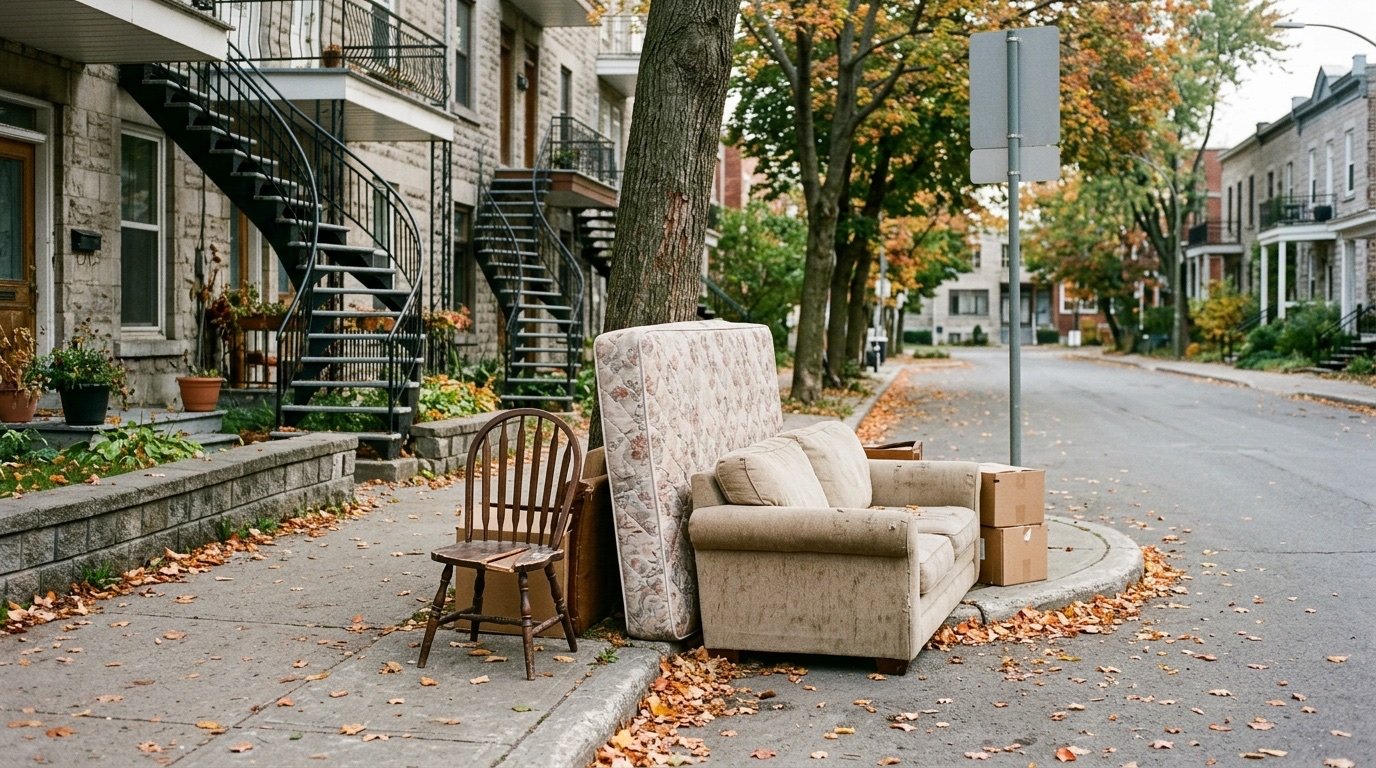
Missed your bulky pickup date? We pick up in 24 to 48 hours in Laval and Montreal. Call (514) 295-2123 or see our residential junk removal in Montreal and Laval.
Sources: Ville de Montreal, collection rules, what to put out, Ville de Laval, bulky items. Checked on September 24, 2026; rules can change.
The Ville de Laval publishes a separate 2026 collection calendar for each zone, as a PDF you can save as a photo or print. Bulky item dates appear alongside garbage, recycling and organics. Because each calendar is specific to a zone, we do not reproduce a table here that could be wrong for your street. This is the reliable method:
For dry materials, the city's Fabreville drop-off area (4026 boul. Dagenais Ouest) and the Vimont ecocentre (1205 boul. Dagenais Ouest) are listed on the city's zone calendars. Renovation waste? See our construction debris junk removal in Montreal. Running a business? Our commercial waste removal in Montreal applies instead of the residential calendar.
An old couch, a broken dresser, a dead washing machine, none of these belong in your regular trash bin, and none of them can just sit at the curb whenever it's convenient for you. Both Montreal and Laval treat "bulky waste" (encombrants) as its own collection category, governed by its own schedule and its own set of rules that are separate from weekly garbage, recycling, and organics pickup.
The problem most residents run into isn't ignorance of the rule itself, it's that the exact dates and details are genuinely hard to track down, differ from one part of the city to another, and change slightly from year to year. This guide pulls together the general logic that applies across Montreal and Laval for 2026, but because bylaws get updated and collection calendars shift annually, always double-check the specific date for your address on your municipality's official site before setting anything out.
If your bulky item situation involves a full residential cleanout rather than just a couple of pieces, or you're dealing with items from a renovation, it's worth reading this alongside our guide on demolition permits and renovation debris in Montreal, since construction material is regulated differently from household bulky items.
Montreal is divided into 19 boroughs, and each one runs its own bulky item ("encombrants") collection calendar. That's the single most important thing to understand about the city's system: there is no one citywide bulky waste pickup date. Rosemont–La Petite-Patrie's schedule doesn't match Verdun's, which doesn't match Côte-des-Neiges–Notre-Dame-de-Grâce's. Most boroughs run bulky item collection roughly once a month, though the exact frequency and the day of the week can vary.
The general rule across boroughs: items must be placed at the curb no earlier than the evening before the scheduled collection date, and ideally not left out for days beforehand. Putting a mattress or a broken chair out a full week early, a common shortcut when people are cleaning out a place before a move, is technically a violation in most boroughs, even if collection eventually happens on schedule.
Items typically accepted include furniture, mattresses and box springs, large appliances, rugs and carpets (usually bundled and tied), and similar oversized household objects. Construction debris, tires, and hazardous materials like paint or chemicals are almost always excluded from this stream and need to go through an ecocentre or a specialized channel instead.
Laval takes a more unified approach than Montreal. Rather than each borough running its own independent calendar, the city publishes a single sector-based collection schedule covering the whole territory, with different sectors assigned different pickup days across the year. If you live in Chomedey, Duvernay, Pont-Viau, Sainte-Rose, or Laval-Ouest, your bulky item date depends on which sector your street falls into, not on a borough-level decision the way it works in Montreal.
This makes Laval's system somewhat easier to plan around once you know your sector, since the whole city follows the same underlying structure, but it also means the calendar published one year isn't guaranteed to line up exactly with the year before, so it's worth re-checking annually rather than assuming last year's date still applies.
Accepted items in Laval mirror Montreal's general list, furniture, appliances, mattresses, while construction and demolition debris, again, falls under separate rules. If you're planning a Laval-area renovation, our Chomedey-Laval debarras page and Sainte-Rose debarras page cover local service details for those sectors specifically.
| Aspect | Montreal | Laval |
|---|---|---|
| Schedule structure | Set independently per borough (19 total) | One citywide sector-based calendar |
| Typical frequency | Roughly monthly, varies by borough | Set number of dates per sector per year |
| Curbside timing | Evening before, per borough rule | Evening before, citywide rule |
| Construction debris | Separate stream, ecocentre or specialized pickup | Separate stream, ecocentre or specialized pickup |
| Fine for early/off-schedule placement | Varies by borough bylaw | Set by city bylaw |
General comparison for planning purposes only, always confirm the current-year specifics for your exact address with the relevant municipality.
Both cities can treat off-schedule curbside placement as illegal dumping, which is a different category of violation than a simple sorting mistake in a recycling bin. In practice, a first offense in most boroughs results in a warning or a tag left on the item explaining the problem, but repeated violations, or a large volume left out clearly outside the collection window, can escalate to a fine. The exact amount depends on the specific borough or municipal bylaw in effect, and it's not something we'll speculate on here since it changes and varies by jurisdiction; check directly with your borough or with the Ville de Laval for the current figure.
Beyond the fine risk, there's a more common everyday problem: items left out too early tend to get picked through, weathered by rain, or scattered by wind before the actual collection truck arrives, which can leave a mess on your street that neighbours notice and that you're still responsible for. This is one of the more overlooked reasons people end up calling a residential junk removal service instead of relying on the municipal date, not just to avoid the fine, but to avoid the item sitting out looking abandoned for days.
A once-a-month collection date sounds manageable until you're the one staring at a couch that needs to be gone in three days because a new tenant moves in, a home sale closes, or a lease ends. This is where the gap between "technically legal" and "actually workable" shows up most clearly. If your item became waste the day after your borough's collection date passed, you're looking at nearly a full month of storage, in a hallway, a garage, or worse, curbside where it risks a fine.
A junk removal service closes that gap directly. We don't run on the municipal calendar, so a couch that needs to leave your home tomorrow can leave tomorrow, sorted properly (donation first, recycling next) rather than sitting curbside hoping nobody complains before the scheduled truck comes around. This matters especially for anyone managing a pre-listing cleanout before selling a home, where the closing date rarely lines up conveniently with a borough's bulky item schedule.
One of the most common mix-ups we see: someone assumes their renovation debris, drywall, old cabinets, flooring, a torn-out bathroom vanity, can go out with the regular bulky item collection. It almost never can. Bulky item pickup in both Montreal and Laval is built for household furniture and appliances, not construction, renovation or demolition (CRD) material, which is subject to its own separate rules, often requiring an ecocentre trip, a rented bin, or a specialized construction cleanout service.
If you're mid-renovation and unsure which category your debris falls into, a torn-out kitchen counter is construction debris, but the old fridge you're replacing is bulky household waste, our detailed breakdown in demolition permits and renovation debris in Montreal covers the distinction and what permits might apply to the renovation itself.
To be fair to the municipal system: bulky item collection through Montreal or Laval is free, funded through municipal taxes, and for a resident with no time pressure and just one or two items, it remains the most economical option. The tradeoff is entirely about timing and volume. Waiting for the scheduled date works fine for a single armchair you're in no rush to get rid of. It works far less well for a full apartment's worth of furniture, an estate cleanout with a tight timeline, or several bulky items scattered across a multi-week renovation project.
For a sense of what a paid alternative costs when timing matters more than saving on a free collection, our complete Montreal junk removal price guide for 2026 breaks down real price ranges by volume, so you can weigh the wait against the cost.
| Situation | Municipal collection | Good Bye Junk pickup |
|---|---|---|
| 1-2 items, no rush | Free, wait for scheduled date | $150 – $300, available within days |
| Several items, moderate timeline | Free, but must fit the once-monthly date | $400 – $700, scheduled around your needs |
| Full apartment or estate volume | May require multiple collection dates | $800 – $1,500+, done in one visit |
Indicative pricing for Montreal, Laval and surrounding sectors, confirmed on-site based on real volume and access.
Municipal bulky item bylaws are written with a fairly simple scenario in mind: a single-family home with direct curbside access. Reality in Montreal and Laval often looks different, a fourth-floor walk-up, a condo building with a shared loading dock, or a laneway house where "curbside" isn't a straightforward five-second walk. Getting a queen mattress down three flights of stairs and to the actual curb by the required window is its own logistical project, and it's a big part of why so many multi-unit residents skip the municipal date entirely and call a service that handles the carrying as well as the disposal.
If access is the real obstacle rather than the bylaw itself, this is worth reading alongside our dedicated piece on the topic.
Because Montreal's system runs borough by borough, and even within Laval the sector assignment matters, the single most useful thing you can do before setting anything at the curb is confirm the actual date for your specific street, not a general "once a month" assumption. Boroughs and the Ville de Laval both publish yearly calendars, and many residents find it easiest to sign up for a reminder or check right before a planned cleanout rather than trying to memorize a recurring date months in advance.
We serve addresses across both systems, from Côte-des-Neiges–NDG and Rosemont in Montreal to Chomedey, Duvernay and Pont-Viau in Laval, and our team stays current on which bylaws apply where, so you don't have to cross-reference a borough map before booking a pickup. See the full list on our service areas page.
We pick up on your timeline, independent of the borough or sector calendar.
Nothing sits curbside outside a legal window, so there's no illegal dumping exposure.
Stairs, elevators, tight hallways, we carry it out, you don't wrestle it to the curb yourself.
Donation and recycling prioritized, same principle municipal bylaws are built around.
Whether it's a single mattress or a full residential cleanout, we work around the bylaw rather than against it, and for renovation-related debris that doesn't qualify for bulky item collection at all, our construction cleanout service covers that separate category.
It's not just homeowners who run into this. A small business clearing out old office furniture, retail fixtures, or equipment when relocating or closing a location faces the same curbside-timing restrictions, often with less flexibility since business leases and turnover dates are rarely negotiable. If you're managing a commercial cleanout on a tight deadline, our commercial waste removal page covers how we handle office and retail volumes without relying on a municipal bulky item date that may not land before your lease ends.
Not every bulky item is treated the same way even within the bulky waste stream, and this is where a lot of otherwise well-intentioned residents trip up. Mattresses and box springs are generally accepted curbside on bulky item day in both Montreal and Laval, but some boroughs ask that they be wrapped or at least kept dry and intact rather than falling apart at the curb, a soaked, disintegrating mattress left out in the rain for days can get refused outright.
Appliances containing refrigerant, fridges, freezers, air conditioners, dehumidifiers, fall under a stricter category almost everywhere in Quebec because of the regulated refrigerant gases inside them. Many boroughs and Laval itself require these units to be flagged separately or collected through a specific stream rather than mixed in with a regular furniture pickup, precisely because the refrigerant has to be recovered properly rather than vented into the atmosphere when the unit is crushed. If you're not sure whether your old fridge qualifies for standard bulky pickup or needs a separate booking, that's exactly the kind of detail worth confirming with your borough, or simply handed to a service that already knows the distinction.
Small electronics, old TVs, computers, printers, are usually excluded from bulky item collection entirely and need to go through a dedicated e-waste collection point or ecocentre instead, since they contain recoverable metals and components that shouldn't be crushed alongside furniture. See our guide on appliance disposal and recycling in Montreal for a closer look at how major appliances specifically get processed.
Quebec's traditional moving day on July 1st creates a predictable annual spike in bulky waste across both Montreal and Laval, and it's worth planning around if your own move happens to land anywhere near that date. Municipal bulky item collection dates don't shift to accommodate the moving rush, which means a huge volume of furniture and household items competes for the same fixed pickup windows right when demand is highest, and curbside piles left by outgoing tenants are a common summer sight in rental-heavy boroughs.
If your lease turnover doesn't line up with your borough's or sector's scheduled date, waiting simply isn't realistic, a new tenant moving in days later doesn't want a previous resident's discarded furniture sitting in the hallway or the parking area. This is one of the busiest periods of the year for junk removal bookings generally, so if you know your move is coming, it's worth booking a pickup date well ahead of the actual day rather than trying to arrange something last-minute during the citywide crunch.
This guide focuses on Montreal and Laval specifically since those two municipalities have the most distinct bylaw structures, Montreal's borough-by-borough system versus Laval's unified sector calendar, but South Shore municipalities like Longueuil, Brossard, Saint-Lambert and Saint-Bruno run their own separate bulky waste calendars again, independent of both. If you're on the South Shore, the same underlying logic applies (fixed collection dates, curbside timing restrictions, construction debris excluded) but the actual schedule is set by your own municipality, not by Montreal or Laval's rules. Our Saint-Bruno debarras page and Candiac debarras page cover local service details for South Shore addresses specifically.
Look up your borough's or sector's current bulky item calendar rather than relying on last year's date or a neighbour's memory.
Household furniture goes with bulky item collection; construction debris, tires and hazardous materials need a different channel entirely.
Fridges, freezers and AC units may need a separate booking, check before setting one out with regular furniture.
If your timeline doesn't match the municipal date, book a junk removal pickup rather than risk an early-placement fine.
Working through this checklist before you start moving items to the curb avoids the two most common outcomes we see: a refused pickup that leaves items sitting for another month, or a fine for placement outside the legal window. When in doubt, a quick call to confirm what we can take same-week is usually faster than untangling borough-specific exceptions on your own.
It depends on your collection zone. The Ville de Laval publishes a 2026 collection calendar for each zone that shows bulky item dates, and you confirm your zone by entering your address at laval.ca/search-by-address. According to the city's bulky items page, collection is done once a month from January to November in residential sectors, with no collection in December. If you missed your date, Good Bye Junk picks up bulky items in Laval within 24 to 48 hours.
Enter your exact address at laval.ca/search-by-address to confirm your zone, then open your zone's 2026 collection calendar at laval.ca/collectes. The calendar can be saved as a photo or printed. Use the exact address rather than the neighbourhood name, since zones do not always match names like Chomedey, Duvernay or Pont-Viau.
The Ville de Montreal sets a maximum volume per address that depends on the borough: 5 m3 (176 ft3) in boroughs such as Rosemont-La Petite-Patrie, Verdun, LaSalle or Saint-Laurent, 3 m3 in boroughs such as Le Plateau-Mont-Royal, Le Sud-Ouest or Ahuntsic-Cartierville, and 2 m3 (70 ft3) in Saint-Leonard. Each box or container must not exceed 25 kg (55 lb). Beyond that, you need a private junk removal service.
The city's bulky item and construction residue collection is offered year-round. Enter your address in the city's Info-collectes tool at montreal.ca/services/horaire-des-collectes to see your date.
Furniture, mattresses, large appliances, carpets, and other oversized household items. Construction and renovation debris is treated separately under different rules.
It varies by borough, most run pickup roughly once a month on a fixed schedule. Check your specific borough's calendar since dates aren't citywide.
Laval uses a sector-based schedule for the whole city, generally a set day each month depending on your sector. The calendar is published annually and can shift slightly year to year.
Yes, both Montreal and Laval can treat off-schedule curbside placement as illegal dumping, with fines varying by municipality and escalating for repeat offenses.
Montreal manages collection per borough (19 different schedules), while Laval runs one unified sector-based system citywide. Both restrict curbside placement to specific dates.
It picks up on your schedule instead of the municipal calendar, avoiding weeks of waiting or fine risk, while still sorting materials for donation and recycling.
Planning a pickup? See all of our service areas, including Laval-Ouest. Related reading: Commercial Waste Collection in Montreal: Bins, Containers, Contracts and Real Prices and Commercial Waste Management in Montreal: A Guide for Small Businesses.
We pick up bulky items in Montreal and Laval on your schedule, call for a clear price range.
📞 (514) 295-2123From $150, same-day pickup often available in Montreal, Laval, the North Shore and the South Shore.
GoodBye Junk Montréal
Montreal, QC, Canada
Call nowFree quoteBook onlineAbout us