Retail shop, office, salon, or small food business — here's what actually works for commercial waste and junk removal in Montreal, without the enterprise-scale contracts built for big-box tenants.
Tell us your business type and roughly how much you need cleared — we'll give you a price range before we ever show up.
Call now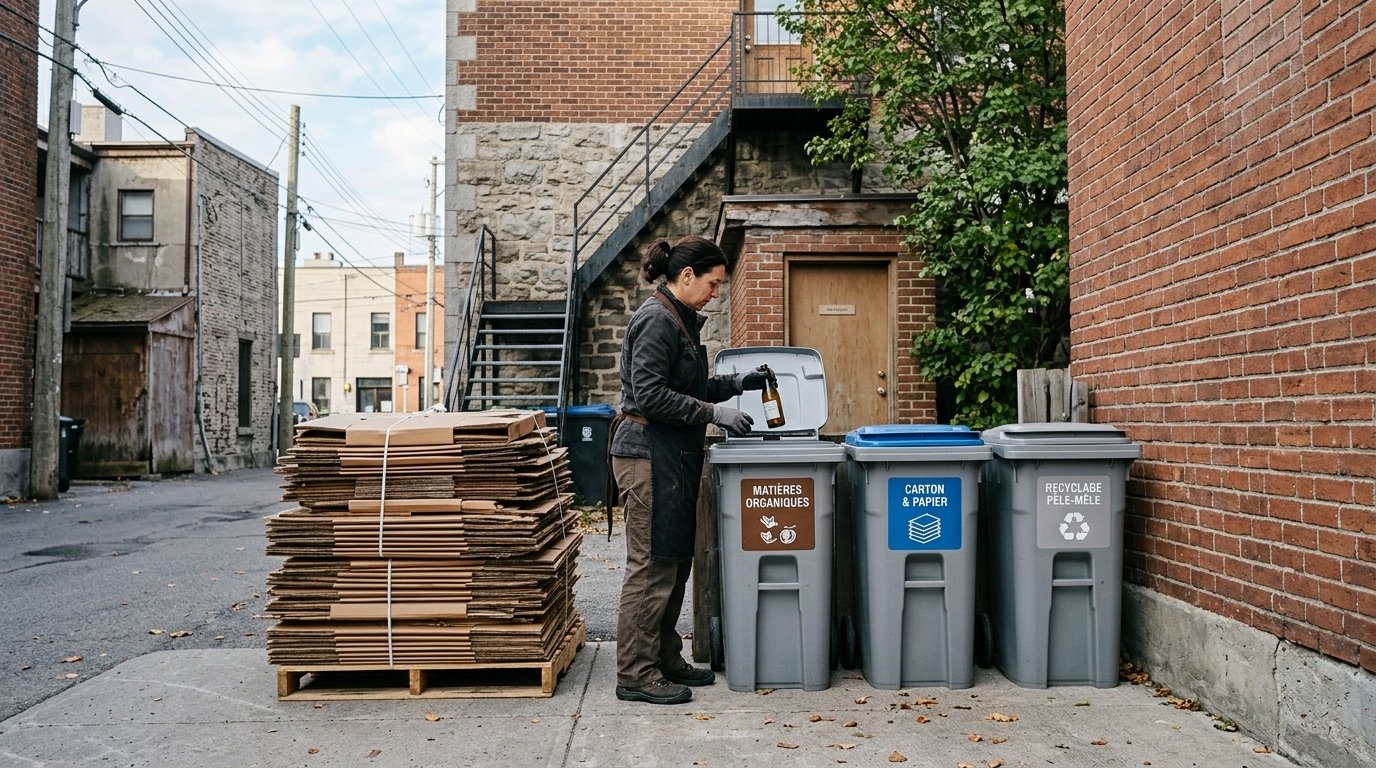
Search "commercial waste management Montreal" and most of what comes back is built for office towers, shopping centers, and multi-site franchise chains — dumpster contracts, tonnage pricing, sales reps who want to talk about a 24-month agreement before they'll even quote a range. If you run a five-employee boutique on a residential strip, a two-chair salon, or a home office that just needs an old server rack gone, none of that fits.
Small business waste in Montreal usually isn't a steady, high-volume commercial stream. It's a mix: a store that needs old fixtures and packaging cleared a few times a year, a restaurant that needs organics and grease picked up weekly, an office purging old furniture during a lease renewal, a clinic disposing of expired equipment. Each of these needs a different answer, and lumping them all into one "commercial" bucket is exactly why so many small business owners in Montreal end up either overpaying for a service built for a much bigger tenant, or under-served by a residential junk hauler that doesn't understand commercial timing and access needs.
This guide walks through what commercial waste actually looks like for a Montreal small business, what it should cost, how Montreal's sorting rules apply to you, and how to tell a service that's actually set up for small business from one that's just repackaging a residential offer. If you land here from a search for commercial waste removal in Montreal, this is the practical, ground-level version of that page.
Old shelving, display cases, office desks and chairs, salon stations, worn-out point-of-sale counters.
Discontinued inventory, damaged product, cardboard and packaging overflow beyond regular pickup capacity.
Old computers, printers, POS terminals, kitchen appliances at end of life.
Organics, grease, packaging from restaurants, cafés, and food-prep businesses — usually needs recurring pickup, not a one-off.
Drywall, flooring, and fixtures from a small buildout or refresh — see our construction debris removal service for larger jobs.
Old files and paperwork that need proper disposal, especially anything with client information on it.
The mix matters because it determines whether you need a one-time cleanout, a recurring schedule, or both. A retail store might need one-time removal of old fixtures during a refresh and nothing else for a year. A restaurant needs recurring pickup practically from day one because food-service waste doesn't wait.
Most Montreal boroughs require commercial establishments — including retail, offices, and especially food businesses — to sort waste into at least three streams: regular trash, recyclables, and organics. The exact requirements and enforcement vary a bit by borough, so it's worth a quick check with your specific borough if you're unsure, but the general expectation across the island is the same: waste that can be diverted from landfill through sorting is supposed to be diverted, not bagged together and sent to the curb.
For a small business, this usually changes two things in practice. First, a food-service business needs a real organics stream, not just a bin that gets ignored — grease and food waste sitting improperly stored creates pest problems fast, especially in summer. Second, any commercial waste removal service you use should be sorting on the back end too, not just hauling everything straight to a transfer station. When we clear commercial waste, recyclable material and anything still usable — fixtures, electronics, furniture — gets pulled out and routed to donation or recycling before what's left goes to disposal, which is both the compliant approach and generally the more cost-effective one over time.
If your business is going through any kind of buildout, renovation, or fit-out — new flooring, wall changes, fixture installation — the debris from that work falls under a different category than day-to-day commercial waste, and usually needs a dedicated construction cleanout rather than a standard commercial pickup.
| Service type | Example | Indicative price |
|---|---|---|
| Small one-time pickup | Old fixtures, a few pieces of office furniture, packaging clear-out | 200$ – 450$ |
| Medium one-time cleanout | Full storeroom or office purge, multiple furniture pieces | 450$ – 900$ |
| Large commercial clear-out | Full unit, restaurant kitchen, large stock disposal | 1000$+ |
| Recurring pickup (monthly) | Weekly or biweekly pickup for ongoing waste — restaurants, salons, retail | 150$ – 400$ / month |
Indicative pricing for Montreal, Laval, and the South Shore, confirmed on-site based on access (loading dock, stairs, alley), actual volume, and frequency for recurring service.
Two things drive price more than anything else: real volume and access. A small storefront on a busy commercial strip with no dedicated loading area takes longer to clear than a unit with direct alley access, even if the volume is identical. Being upfront about access — stairs, elevator availability, parking restrictions — when you first call gets you a much more accurate quote than a generic estimate based on square footage alone.
For businesses that need help figuring out where their situation lands, our commercial waste page has a broader breakdown across business types, and a quick call usually pins down a range in under five minutes.
You're clearing out old stock, furniture, or fixtures during a refresh, closing down a promotion, moving locations, or doing a seasonal reset. It's a defined job with a start and an end.
Your business generates waste continuously that regular municipal pickup can't keep up with — restaurants, cafés, salons with high supply turnover, or any business with volume that outpaces a standard bin schedule.
A lot of small business owners default to calling for a one-time pickup every time things pile up, when a scheduled recurring service at a lower per-visit cost would actually save money and mental overhead. If you find yourself calling for pickup more than once every couple of months, it's worth asking about a recurring schedule instead of treating every visit as a separate emergency.
Retail waste tends to be lumpy — a quiet stretch, then a big push around a seasonal reset, a fixture change, or a lease-related deadline. Packaging overflow and discontinued stock are the two biggest recurring headaches. A one-time pickup scheduled around inventory resets usually covers most retail needs without a standing contract.
Food-service businesses are the clearest case for recurring pickup. Organics and grease don't wait for a monthly cleanout, and pest issues escalate fast when waste sits too long in a Montreal summer. If your restaurant is also thinking about how frequently pickup should happen and what it costs on an ongoing basis, our dedicated guide on recurring waste collection for restaurants and businesses in Montreal goes deeper into scheduling and monthly pricing.
Office waste is usually the most predictable — furniture, electronics, and paper at end of life, often tied to a lease event like a renewal, downsizing, or move. If your office is going through a full move or closure, our guide on commercial space cleanout before closing or relocating covers that scenario specifically, since it involves different timing pressure than a routine cleanout.
These businesses combine specialized equipment (styling stations, treatment chairs, sterilization equipment) with ongoing supply turnover and, often, client records that need careful handling rather than being tossed in with general recycling. A mixed one-time-plus-occasional-recurring approach usually fits best.
A growing number of small Montreal businesses run out of a home office or a basement workspace — consultants, e-commerce sellers storing inventory, tradespeople keeping equipment at home. When that kind of business waste is mixed in with a broader home cleanout, it's worth treating it as one project rather than two separate calls. Our basement cleanout before/after guide is written for the residential side of that situation but the same logistics apply if your business inventory happens to live down there too — one crew, one estimate, done in a single visit.
Most small business owners in Montreal have three practical options for commercial waste: a national franchise operation, a local independent hauler, or a residential-focused service stretched to cover commercial jobs. Each has real tradeoffs.
1-800-GOT-JUNK is the most recognizable national name, with consistent branding and broad coverage, but pricing isn't published anywhere — every job needs a call or an in-person quote before you know what you're working with, and franchise-model pricing tends to run higher than local independents on comparable jobs. We've put together a full side-by-side in our 1-800-GOT-JUNK vs Good Bye Junk Montreal pricing and service comparison if you're actively weighing the two.
Local independents vary a lot in quality and consistency — some are excellent, some have thin service history and inconsistent availability, particularly for anything urgent. What matters for a small business specifically is whether the provider actually understands commercial timing: pickup outside business hours when needed, a real price range given before anyone shows up, and enough flexibility to handle both a one-time job and a recurring schedule without forcing you into a long contract you don't need.
The three things worth asking any provider before booking: do you publish price ranges or do I have to negotiate blind, can you work around my business hours, and what happens to items that are still usable — do they get donated or does everything go straight to landfill.
Separating recyclables and anything donatable ahead of time can reduce the billed volume and speeds up the on-site visit.
If you're calling for one-off pickups more than every couple of months, a recurring schedule at a lower per-visit rate usually costs less over a year.
Scheduling non-urgent cleanouts during off-hours or slower business days can open up more flexible timing and sometimes better rates than a rush request.
If you're clearing commercial waste and also have renovation debris or a separate storage unit to deal with, doing it in one visit avoids paying for two separate truck rolls.
Calling for a rush job repeatedly instead of setting up a recurring schedule usually costs more over time and creates unnecessary stress.
A provider that dumps everything together, unsorted, misses both compliance and cost savings from donation and recycling.
Not mentioning stairs, elevator restrictions, or loading dock limitations upfront leads to price surprises on-site.
Booking a cleanout days before a lease deadline or inspection removes flexibility and often costs more than planning a couple of weeks ahead.
Montreal's commercial calendar has its own rhythm, and it affects waste removal availability more than most business owners expect. July 1st, the province's traditional moving day, pulls a huge share of residential leases and a meaningful chunk of commercial leases with it, since many commercial terms are set up on similar cycles. Anyone planning a business move or a lease-related cleanout around late June or early July should book well ahead — crews get booked up fast during that window, and last-minute requests either get pushed out or cost more for the rush.
Retail businesses see their own seasonal spikes around big sales periods and end-of-season inventory turns, when old stock and packaging pile up fast. Restaurants and cafés often see a jump in volume during patio season, when higher foot traffic means more packaging and organics on top of the usual kitchen waste. Building a rough sense of your own business's seasonal pattern — and scheduling recurring pickups or planned cleanouts around it instead of reacting after the fact — is one of the simplest ways to avoid paying rush pricing.
Winter brings a different challenge: snow and ice affecting loading access, narrower alleys, and shorter daylight hours for outdoor work. A service that's used to operating in Montreal winters plans around this instead of treating every snowfall as a scheduling crisis, which matters if your business relies on predictable pickup timing through the colder months.
A meaningful share of small business waste isn't just physical clutter — it's information. Old client files, invoices, employee records, and anything with financial or personal details on it needs to be handled differently than a stack of cardboard. The safest approach is to separate anything sensitive before a general pickup and route it through a dedicated shredding or secure-disposal service rather than mixing it into bulk recycling, where it's effectively unprotected.
Old electronics carry a similar risk in a different form — point-of-sale terminals, old computers, and networking equipment can hold client and payment data even after a business assumes it's been wiped. Flagging this kind of equipment specifically when booking a pickup means it gets handled with the right precautions rather than tossed in with general e-waste.
We work with small businesses across Montreal, Laval, and the South Shore — from independent shops in Rosemont and Villeray-Saint-Michel to commercial strips in Chomedey and offices in the Sud-Ouest. The full list of areas we cover is on our service areas page, and if your neighbourhood isn't listed there, call anyway — we cover more ground than the page lists and can usually confirm availability on the spot.
Commercial strips have their own access quirks that a crew needs to already know rather than figure out on the fly. A boutique on a Plateau or Mile End retail street often means no dedicated loading zone and a short curbside window before a parking ticket becomes part of the job cost. A business in a Hochelaga-Mercier or Anjou strip mall usually has easier truck access but shared dumpster arrangements with neighbouring tenants that need to be worked around so nothing gets mixed up. Ground-floor commercial space in an older Montreal building can mean a narrow front door, a step down to a basement storage area, or a rear alley that's only wide enough for a smaller vehicle — all things worth mentioning when you first call so the crew shows up with the right setup.
Laval and South Shore businesses tend to have more predictable loading access — strip malls, standalone buildings, and business parks with proper docks or drive-up entries — but they also cover more ground per stop, which is part of why we schedule multiple businesses in the same sector on the same day when we can. If you run a small business in Saint-Bruno, Candiac, or elsewhere on the South Shore and want to coordinate pickup with a neighbouring business to split a truck visit, mention it when you call — it's a common enough request that we can usually accommodate it.
Commercial waste management for a small business in Montreal doesn't need to mean a long-term contract built for a shopping mall tenant, and it doesn't need to mean improvising with a residential junk hauler every time something piles up. The right setup is usually a mix: a clear one-time price range when you need a cleanout, and a recurring option when your business generates waste faster than standard pickup can handle — with sorting and donation built into both, not treated as an afterthought.
If you're not sure which category your business falls into, a quick estimate request is the fastest way to find out. Describe your business type, roughly how much needs to go, and how often — we'll tell you honestly whether a one-time visit or a recurring schedule makes more sense, and give you a real number before committing to anything.
A one-time pickup for a small retail store or office typically runs 200$-450$, a medium volume clear-out lands between 450$-900$, and larger commercial loads or ongoing service can exceed 1000$. Recurring pickup usually falls between 150$-400$ per month depending on frequency and volume.
Most Montreal boroughs require commercial establishments, including food businesses, to sort recyclables and organic waste separately from regular trash, with details varying slightly by borough.
One-time removal handles a specific clear-out. Recurring service is a scheduled pickup for waste a business generates continuously, like a restaurant's organics or a retail store's packaging.
Yes. Describing volume and waste type gets a price range before anyone shows up, confirmed on-site before work starts.
Yes. Usable furniture, fixtures, and equipment are prioritized for donation or resale before recycling or landfill.
The core service is similar, but published pricing transparency and local availability differ — see our full pricing comparison for details.
Planning a pickup? See all of our service areas, including Pointe-Claire. Related reading: Mandatory Waste Sorting in Montreal: 2026 Bylaw Guide and Donate vs Recycle vs Landfill: What Actually Happens to Your Junk in Montreal.
Call us for a clear price range, one-time or recurring — no long contract required.
📞 (514) 295-2123From $150, same-day pickup often available in Montreal, Laval, the North Shore and the South Shore.
GoodBye Junk Montréal
Montreal, QC, Canada
Call nowFree quoteBook onlineAbout us