A couch dragged to the curb three days too early. A mattress sitting in the rain for six weeks because nobody knew December's collection got cancelled. A family mid-estate-cleanout who discovers, the night before, that the next pickup in their sector is two months away. The bulky item calendar looks simple on paper — in real life, it trips up an enormous number of people across Montreal and Laval. Here's everything you need to know for 2026, so it doesn't happen to you.
We come pick up your bulky items on the date that works for you — not your borough's date.
Call now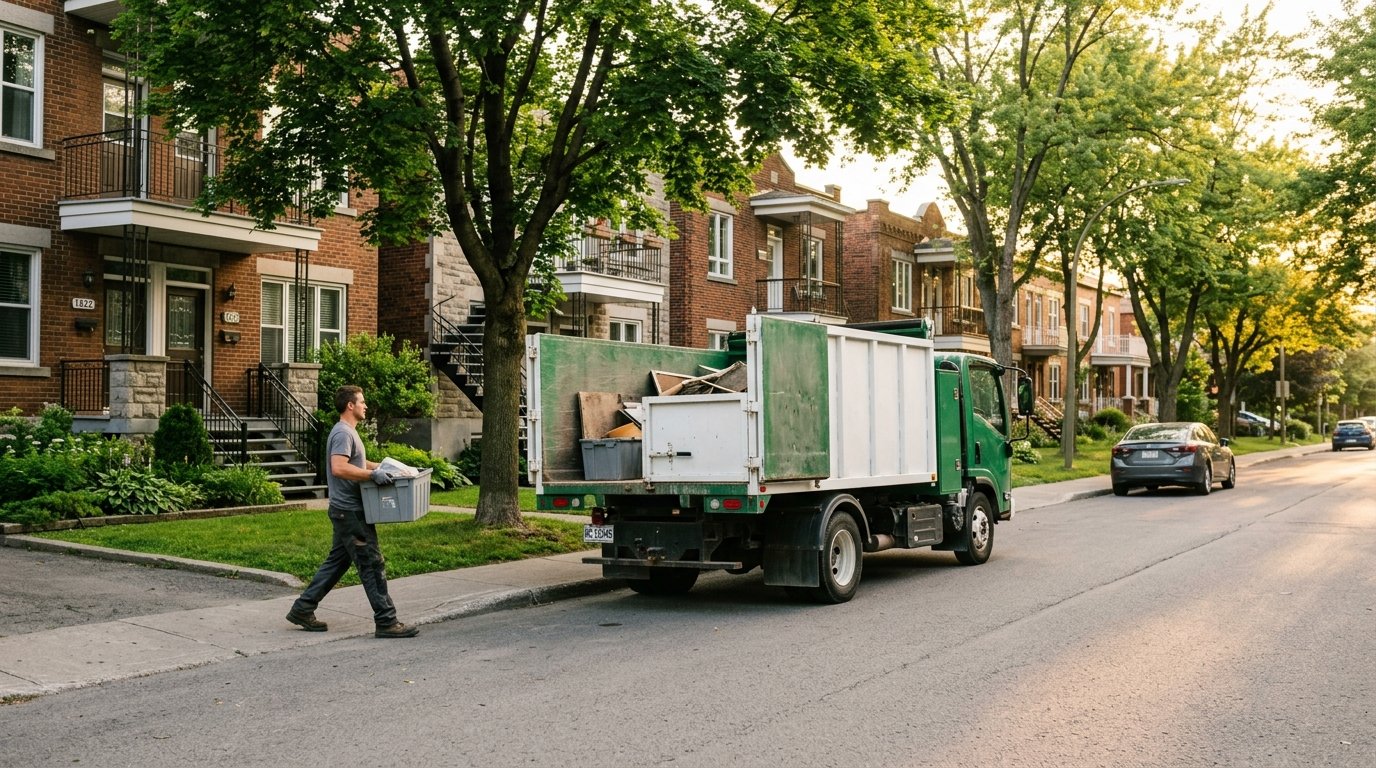
Ask a hundred Montrealers to explain how bulky item collection works in their neighbourhood and you'd probably get a hundred different answers — and half of them would be dead wrong for the borough next door. That's not carelessness. It's that the system is, objectively, complicated. Montreal has 19 boroughs, and each one publishes its own calendar, with its own frequency, its own curbside timing rules, and sometimes its own list of what actually qualifies. Laval works differently, with a more centralized sector-based structure, but it's just as capable of catching out anyone who assumes, wrongly, that "it's the same everywhere."
The result is a predictable wave of frustrated calls every year — not because people did anything seriously wrong, but because they fell into one of the calendar's classic traps: the wrong date, the wrong item, or simply the wrong time of year to expect a fast pickup. This guide exists to head that off. We'll walk through the real rhythm of the calendar across 2026, the mistakes that come up most often, a handful of tricks most people never hear about, and — for the moments when the municipal calendar genuinely can't keep up with your deadline — the alternative that exists.
And because bulky item season always drags a few strange stories along with it, it's worth a detour to our piece on the weirdest items we've found clearing out houses in Montreal — once you start talking about what people leave at the curb, it's hard to stop.
Nobody has a live counter running on this, but when you add up the volume that actually crosses our path on the ground — a couch here, a fridge there, entire estate-cleanout loads elsewhere — the scale is genuinely striking. Based on typical volumes we see across a full year, households in Greater Montreal set out the equivalent of tens of thousands of tonnes of bulky items annually: furniture, mattresses, appliances, estate belongings, and everything in between that never finds a taker. A good chunk follows the municipal calendar, another share ends up at an ecocentre, and a growing slice goes through a private service simply because the calendar and the moment people actually need help almost never line up.
What's more striking than the volume itself is how often a still-perfectly-usable item ends up at the curb only because nobody took two minutes to check whether it could be donated first. We'll come back to that later in this guide, but if the money side of that equation interests you, our article on how much money Montrealers throw away without realizing it every year digs into the question in more depth.
Before we get into specific dates, there are three rules that hold true almost everywhere across Montreal and Laval, regardless of your sector:
Unlike weekly garbage or recycling, bulky items run on a separate calendar — often monthly, sometimes every other month — specific to your exact sector.
The vast majority of sectors only allow items out the evening before pickup — never several days ahead of time.
Furniture and appliances are generally fine. Paint, construction debris, tires, and hazardous materials almost never are.
The complication is that these three basic rules play out differently depending on exactly where you live. That's precisely why a generic calendar taped to your fridge stops being useful after the first year — you need to check every season, because boroughs adjust their dates more often than people expect.
Before dates even enter the picture, there's a distinction that escapes a huge number of people and explains roughly half of all refused pickups: bulky item collection and construction/renovation debris management are two completely separate systems, with different rules, and they can't be mixed.
A couch, a mattress, a dresser, a fridge, a washer, a rolled-up rug, estate boxes, outgrown kids' toys, a broken bike. Basically, everyday household items that reached the end of their useful life.
Drywall, structural wood, tile, concrete, asphalt shingles, insulation, removed windows and doors, plumbing pipes — anything coming out of a demolition or renovation. This material follows entirely separate rules, often tied to a permit depending on the scope of the work.
The classic trap: someone renovating a bathroom uses bulky item day to also get rid of the old tile and structural wood they tore out. In almost every sector, that's not eligible, and it can get the entire load refused — bulky items included. If your project involves this type of material, our construction cleanout service is built specifically for this kind of debris, with direct pickup or bin-based options, and it sidesteps the municipal calendar and its quantity limits entirely.
Rather than list exact dates that risk changing from one borough to the next (and that you'll need to verify on your sector's official site anyway), here's the seasonal picture we watch play out year after year on the ground. This rhythm matters far more for planning purposes than any single printed date.
This is the slowest stretch of the year for bulky item collection. Several Montreal boroughs space out their cadence or suspend the service outright during the coldest months, largely because winter conditions make the job harder for crews working snowy or icy sidewalks. Laval slows down too, though the degree varies by sector. The catch is that this slowdown lands right when a lot of people actually need to clear out a home — a death in the family requiring an estate cleanout in the dead of winter, early planning for a July 1st move, or just a big post-holiday purge.
The moment the snow melts, demand explodes. The traditional spring clean-out pushes a huge number of households to finally set out everything that's been sitting since fall, and boroughs generally pick their pace back up. It's also the window when July 1st move planning ramps up — people start sorting what they're keeping and what's getting left behind well ahead of the actual date. The result: calendars run more often, but so does demand, which can stretch out the wait even for a "regular" collection if your sector sees an unusually heavy volume.
July 1st is, without exaggeration, the single busiest stretch of the year for anything bulky-item-related in Montreal. Furniture abandoned by outgoing tenants, items that don't fit in the new place, mattresses left behind because "it costs more to move than to replace" — it all converges at once. Sidewalks in some rental-dense neighbourhoods turn, for a few days, into genuine furniture corridors. This is also when collection delays stretch the longest, simply because volume exceeds what a normal pickup is built to absorb.
After summer's chaos, fall settles back into a more predictable rhythm. It's often the best stretch to plan a non-urgent cleanout, since the calendar returns to its normal cadence and demand isn't as concentrated as spring or summer. It's also a solid window for renovation projects that run through the fall before winter sets in.
December deserves its own callout because it's the month that catches the most people off guard. Between the holidays, vacations, and a general slowdown, it's easy to assume a normal collection will happen as scheduled — only to discover it's been moved, cancelled, or simply pushed to January. If you're planning a cleanout in December, check your sector's calendar first, before you start sorting anything.
The most common reflex: you finish sorting on a Sunday, so everything goes out that day even though pickup isn't until Thursday. In most sectors, that's a violation — and it gives your neighbours four days to complain.
"My brother in Rosemont says it's the first Tuesday of the month" means absolutely nothing for Villeray, NDG, or the Sud-Ouest. Every borough runs its own calendar, full stop.
A can of paint sitting next to your couch can get the entire load refused, not just the problem item — collection crews sometimes just skip the whole pile.
See the section above — December is the most frequently changed or cancelled month, and not everyone notices in time.
A full basement or estate cleanout often exceeds what a single municipal pickup is meant to handle, even if every item individually would qualify.
Changing address often means changing boroughs or sectors — and therefore a completely different calendar. Your old habit no longer applies.
A home sale closing in ten days, a lease ending July 1st, an estate that has to be cleared before a legal date: if the next collection falls after your deadline, the municipal calendar simply can't help you in time.
After years working sectors across Montreal, Laval, and the South Shore, here are a few habits we rarely see from people who call us after missing their date — but that make all the difference for people who plan well.
Even if it's not urgent yet — an aging parent whose house you know will eventually need clearing out, a renovation project you're planning for next year — write down your sector's next collection date right now. It gives you an immediate reference point: does the timing actually work, or is a private service the better call?
Sector boundaries for collection don't always match what residents call their neighbourhood. That's true in Montreal and just as true in Laval, where sector lines don't necessarily follow the informal borders of Chomedey, Duvernay, or Pont-Viau. Entering your precise address in the official tool avoids the classic "I assumed it was the same as my neighbour's" mistake.
Before you even think about a date, split everything into two piles: what will clearly pass in a regular collection (furniture, mattresses, simple appliances) and what never will (liquid paint, construction debris, tires, hazardous materials). This avoids losing an entire pickup over one misplaced item, and it tells you immediately whether you'll need an ecocentre or a private service on top of the municipal calendar.
If a date is approaching — a sale, a lease, an estate — and your sector's next collection falls after that date, don't gamble on "it'll probably work out." Book a private service in parallel. It's often far cheaper than the stress of a couch stuck on the curb the day before a buyer walkthrough.
| Aspect | Montreal | Laval |
|---|---|---|
| Structure | 19 separate calendars, one per borough | More centralized, organized by geographic sector |
| Typical frequency | Monthly to bimonthly, slower in winter | Fixed annual dates per sector, also slower in winter |
| Peak of the year | Spring and July 1st | Spring, more spread out than Montreal |
| Curbside timing | Generally evening before only | Generally evening before only |
| Construction debris, tires, paint | Never eligible, ecocentre required | Never eligible, ecocentre required |
Exact calendars change year to year and sometimes mid-year — always check your borough's site or the Ville de Laval for official 2026 dates. This table gives a general planning picture, not day-by-day dates.
There's a third path people often forget exists between "wait for municipal collection" and "call a private service": bringing items yourself to an ecocentre. It's worth considering in certain specific cases, but it has its own real limits that are worth knowing before you load up the car.
A small volume, a handful of items, a vehicle big enough to haul it, and — critically — free time to make the trip, ideally on a weekday, since lines can stretch out on weekends, especially in spring.
A large volume (full basement, estate), heavy furniture one person can't lift alone, a home without easy vehicle access, or simply no time for multiple trips during limited opening hours.
Most ecocentres across Greater Montreal and Laval accept a wider range of materials than regular bulky item collection — often including certain electronics, paint, and small quantities of household hazardous waste — but with per-visit quantity limits and sometimes fees for categories like large-volume construction debris. It's a solid complementary option for materials the municipal calendar rejects, but rarely a practical solution on its own for a full home cleanout, simply because of the time and transport logistics involved.
This isn't an official calendar — just the general picture we observe sector by sector, useful for knowing what to expect before confirming the exact date on the municipal site. Rental-dense sectors tend to see a sharp spike around July 1st, while more residential, single-family sectors run a steadier rhythm year-round.
Very rental-dense sectors — a sharp spike around July 1st, monthly cadence the rest of the year.
A mix of apartment towers and residential streets — check whether your building has a grouped-collection policy before relying on the borough calendar.
Generally monthly cadence, with a marked winter slowdown like everywhere else in Montreal.
Heavy renovation activity in the area — watch for the classic mistake of mixing construction debris with eligible bulky items.
More residential sectors, generally steadier rhythm, less of a summer spike than downtown.
Centralized calendar by geographic sector — check by exact address, since boundaries don't always follow neighbourhood names.
This picture is indicative and based on what we see on the ground, not official calendars — the only reliable source for an exact date remains your borough's site or the Ville de Laval.
The municipal calendar has one obvious advantage: it's free. But it also has real limits — a fixed date, a limited quantity, a restricted list of materials, and a wait that can stretch several weeks if you miss the window or your sector is in a slow stretch. For a lot of situations, that timeline simply doesn't work.
That's where a private residential cleanout service steps in: we come on the date that works for you, not the borough's, and we accept a far wider range of materials than municipal collection. For situations where every day counts, our 24-48h emergency service lets us move far faster than a multi-week wait — useful before a home sale, after a disaster, or ahead of a lease deadline that's coming up fast.
For an estate cleanout, which usually calls for a different approach than the standard calendar — respectful sorting, family coordination, sometimes a notary involved — our estate cleanout page explains exactly how that works in practice. And if the volume is significant but you'd rather manage the pace yourself over several days, container rental remains a flexible option that also sidesteps the municipal calendar entirely.
| Volume | Example | Indicative price |
|---|---|---|
| A few items | A couch, a mattress, a dresser | $150 – $300 |
| Quarter to half load | Several pieces of furniture, appliances, mixed materials | $400 – $700 |
| Full load | Full cleanout beyond the municipal limit, estate volume | $800 – $1,500+ |
Indicative pricing for Montreal, Laval, and the South Shore, confirmed based on real volume and access (elevator, stairs, laneway). Once you weigh it against the real cost of waiting several weeks — fine risk, an item sitting out, a missed deadline — a one-time private cleanout often costs less than people assume.
It doesn't have to be all one or the other. Most of our best-organized clients use a fairly simple mixed approach: simple, non-urgent items get saved for the next free municipal collection, while everything else — ineligible materials, volume that far exceeds the limit, or a situation that can't wait for the next cycle — goes through a private service.
The practical method: as soon as you know a cleanout is coming, check the date of your sector's next collection. If it falls within your timeline and the volume is reasonable, that's the free option to go with, no hesitation. If the date is too far off, the volume clearly exceeds what a normal drop-off can absorb, or part of the material simply isn't eligible, a call for a residential cleanout on your own schedule solves it in one shot, without waiting and without risking a fine.
There's a scenario that comes back year after year, almost identical from one family to the next. A parent passes away or moves into a care residence, often in late fall or the middle of winter. The family needs to clear the house — a basement packed with decades of accumulation, a garage full of tools, entire rooms of furniture. There's a legal or real-estate deadline pressing in: a notary sets a date, or the house is already listed with a closing date approaching. And that's exactly the moment someone checks the municipal calendar — only to discover the sector's next bulky item collection is six or eight weeks out, right in the middle of the winter slowdown.
This is exactly the kind of situation where the free calendar, useful as it is the rest of the year, simply can't keep pace with real life. The answer isn't to force it — setting out extra bags hoping the collection takes them, or piling furniture on a balcony until spring — but to recognize early that the volume and the timeline exceed what municipal collection can absorb, and to book an estate cleanout that respects both the family's emotional pace and the legal or real-estate deadline. We also regularly find items of sentimental or practical value overlooked in the rush — a topic we cover in more depth in our article on the weirdest items we've found clearing out houses in Montreal, which shows just how many surprises an estate basement can hold.
One part of the bulky item calendar that few people question: what actually happens to items once they leave the sidewalk? The honest answer is that it depends heavily on the channel. Standard municipal collection typically routes everything to a sorting facility or, in plenty of cases, straight to landfill — crews don't have the time or the mandate to sort out what could still be useful. A couch in great condition and a broken dresser often end up in the same truck.
That's where a meaningful amount of value gets lost, literally. We estimate that a significant share of what gets set out at the curb across Greater Montreal every year could have found a second life — donated, resold, reused by someone else — if it had been sorted and offered up before entering the general collection stream. That's exactly the kind of thing we break down in our article on how much money Montrealers throw away without realizing it every year, which puts a number on the scale of the phenomenon. A private cleanout service that prioritizes donation and reuse before recycling, rather than routing everything to the same destination, genuinely changes what happens to your items — and keeps a still-usable piece of furniture from getting buried simply because it went out the same day as everything else.
The calendar gets even trickier once you add renting or condo ownership into the mix. If you're a tenant, the technical responsibility for following the calendar sometimes falls to the landlord depending on the lease, but in practice it's often the tenant who ends up setting items out — and who gets stuck with the fine if something's done wrong, even unknowingly. Before setting furniture out, always check whether your building has an internal policy, especially in triplexes and quadruplexes where several units share the same curbside space.
In condos and larger residential complexes, plenty of syndicates flatly prohibit individual bulky item placement, preferring to coordinate a group collection or requiring residents to handle disposal on their own. This is especially common in downtown condo towers and in several large Laval complexes, where building appearance takes priority over the simplicity of the municipal calendar. In these cases, arranging a cleanout directly with a private service sidesteps the whole issue — especially since these buildings often have access constraints (reserved elevator, loading dock, time window) that make municipal collection impractical anyway.
Even within the bulky item stream, not everything follows identical rules, and this is where a lot of otherwise well-organized households trip up. Mattresses and box springs are generally accepted on collection day across most Montreal boroughs and Laval, but plenty of sectors ask that they stay dry and intact rather than falling apart at the curb — a soaked, disintegrating mattress left out for days in the rain can get refused outright, which means starting the whole wait over again.
Appliances containing refrigerant — fridges, freezers, window air conditioners, dehumidifiers — sit in a stricter category almost everywhere in Quebec, because of the regulated refrigerant gases sealed inside them. Many boroughs and Laval itself require these units to be flagged separately or collected through a specific stream rather than mixed in with a regular furniture pickup, precisely because the refrigerant needs to be recovered properly rather than vented when the unit gets crushed. If you're not sure whether your old fridge qualifies for standard bulky pickup or needs its own booking, that's exactly the kind of detail worth confirming with your borough before it sits curbside for a week untouched.
Small electronics — old TVs, computers, printers, monitors — are usually excluded from bulky item collection entirely and need to go through a dedicated e-waste drop-off point or an ecocentre instead, since they contain recoverable metals and components that shouldn't get crushed alongside furniture. This is one more reason a single "just put it all at the curb" mentality backfires: a mixed pile with one wrong item can get the whole thing skipped by the truck.
It isn't only residents who get caught by this. A small business clearing out old office furniture, retail fixtures, or equipment when relocating or closing a location faces the exact same curbside-timing restrictions — often with less flexibility, since commercial leases and turnover dates are rarely negotiable the way a personal moving date sometimes is. A retailer with a lease ending on the 30th doesn't get to wait for a bulky item date that happens to fall on the 15th of the following month; the space needs to be empty regardless of what the municipal calendar says.
If you're managing a commercial cleanout on a tight deadline, our commercial waste removal service covers office and retail volumes without relying on a municipal bulky item date that may not land before your lease ends — which, in practice, is the reason most business cleanouts skip the calendar entirely and book a fixed date instead.
Selling a property brings its own calendar pressure, and the bulky item calendar rarely lines up with it conveniently. Between listing, showings, an accepted offer, and closing, the real window to clear out a home or apartment is often measured in days, not weeks — and certainly not months if your sector's next collection falls right in the middle of the winter slowdown.
The most common scenario: a real estate agent recommends decluttering before photos and initial showings, so rooms present as larger and brighter. That's excellent advice, but it often means clearing out content well before the next collection date rolls around. Waiting on the municipal calendar in this context can literally cost weeks of market time, with delayed showings or weaker photos while a basement or garage stays cluttered.
Then, once an offer is accepted, there's often an even tighter window between acceptance and closing to fully clear the space — especially if the seller is moving out at the same time as they're managing the transaction. In this context, scheduling a residential cleanout for a specific date chosen around the transaction's timeline, rather than the municipal calendar, avoids the stress of a still-full basement the night before handing over the keys. For cases where the closing date is approaching fast, our 24-48h emergency service remains the most reliable option for meeting a deadline that isn't moving.
Whatever your sector's calendar looks like, we cover the whole territory with the same simple approach: a date that works for you, not the borough's. Our regional pages break down the offering by area: Montreal cleanouts, Laval cleanouts, North Shore, and South Shore, including sectors like Rosemont, Villeray–Saint-Michel, Côte-des-Neiges–NDG, Longueuil, Brossard, and Rosemère. You can also check the full list of service areas to confirm your exact sector.
Enter your exact address into your borough's or the Ville de Laval's official tool — not a neighbour's or friend's calendar.
As soon as you know a cleanout is coming, note the next collection date to compare against your real timeline.
Separate what's eligible from what never is (paint, construction debris, tires) before putting anything at the curb.
Set items out the evening before only, never several days ahead.
The winter slowdown can shift or suspend collection — check before assuming a pickup will happen as usual.
For a tight deadline (sale, lease, estate), book a private cleanout in parallel rather than hoping the municipal calendar keeps up.
Each Montreal borough publishes its own annual calendar on its own website, usually under the waste collection section. The most reliable method is entering your exact address into the official collection lookup tool rather than trusting a printed calendar or a neighbour's schedule from a different sector.
No. Montreal operates through 19 boroughs, and each one manages its own calendar with its own dates and its own frequency. Laval runs a more centralized system, organized by geographic sector across the whole city instead.
You can wait for the next scheduled date (sometimes several weeks later), bring items yourself to an ecocentre, or book a private junk removal service that comes on the date that works for you instead of waiting for the municipal cycle.
Most Montreal boroughs and Laval's own service space out or partially suspend bulky item collection between December and March, largely because winter conditions make the job harder for collection crews working the streets.
Municipal collection is free, but a private cleanout often costs less than people assume once you weigh it against the real cost of a long wait: fine risk, items sitting out for weeks, or a tight deadline (sale, lease, estate) that simply can't wait.
Yes, and it's often the smartest approach: save the simple items for the next free collection date, and book a private cleanout only for what exceeds the eligible volume, the rejected materials, or a genuinely urgent situation that can't wait for the next cycle.
Planning a pickup? See all of our service areas, including Laval-Ouest. Related reading: Basement Cleanout in Montreal: The Complete Before/After Guide and Basement Renovation in Laval: Managing Debris Efficiently.
We come pick up your bulky items on the date that works for you, no matter your sector or borough.
📞 (514) 295-2123From $150, same-day pickup often available in Montreal, Laval, the North Shore and the South Shore.
GoodBye Junk Montréal
Montreal, QC, Canada
Call nowFree quoteBook onlineAbout us