A basement renovation generates more debris than most homeowners expect — old framing, drywall, flooring, ceiling tile, sometimes decades of stored belongings on top of it. Here's how to manage it efficiently, from container vs pickup to pricing and access.
Tell us the scope of the basement project — we'll recommend container or pickup and give you a clear price.
Call Now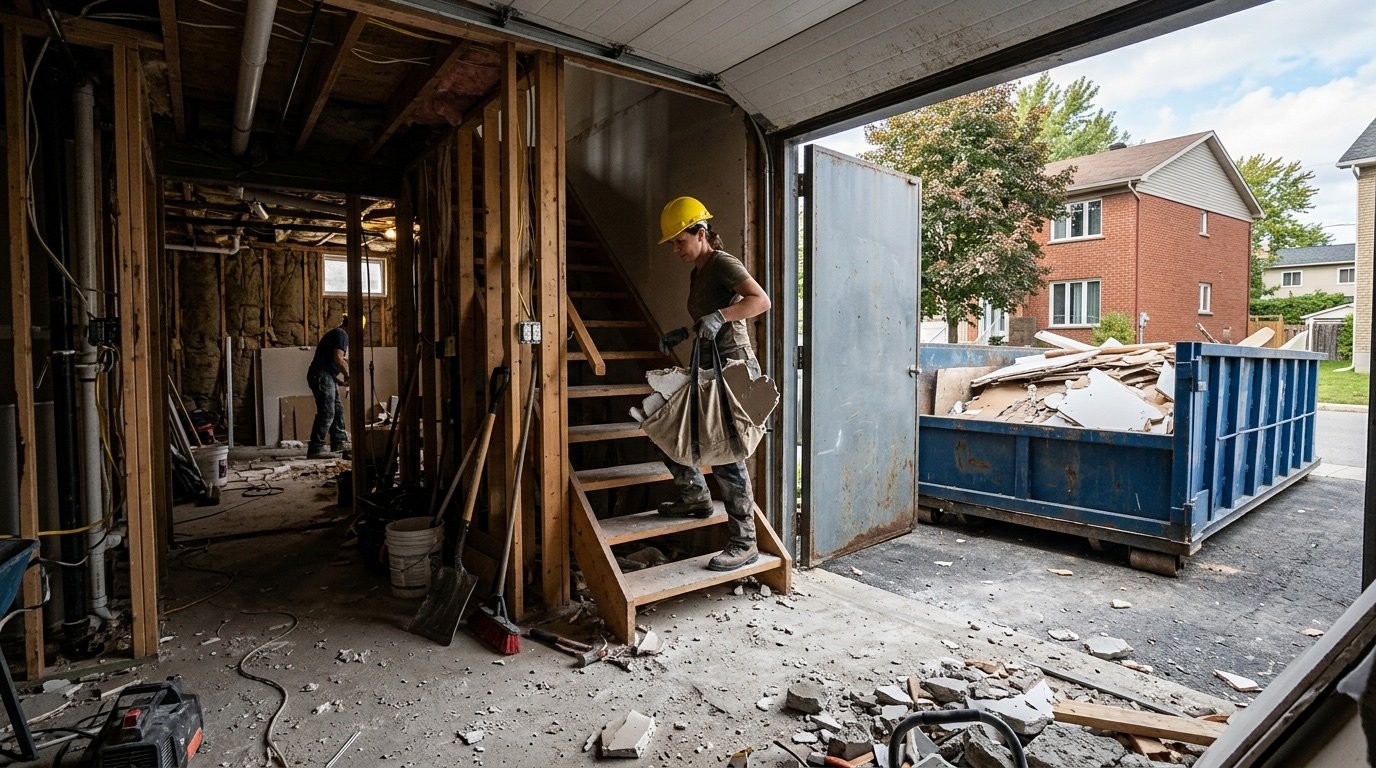
Laval's housing stock — bungalows, split-levels, and larger detached homes built from the 1960s through the 1990s — tends to have real, usable basement square footage, which is exactly why so many renovation projects start there. Turning an unfinished or dated basement into a family room, home office, or rental unit is one of the most common projects our construction debris removal crews handle across Laval. But basements come with a specific debris problem: they're often the last part of a house to get any storage discipline, so a demolition project doesn't just produce framing and drywall — it also uncovers decades of stored boxes, old furniture, holiday decorations, and things nobody remembers putting down there.
This guide covers how to think about debris management for a Laval basement renovation from the planning stage through to the final cleanup — container versus pickup, realistic pricing, sorting requirements, and the access details that are specific to Laval's housing types.
Best for a full gut renovation running more than a few days — framing removal, drywall demolition, flooring pulled up, possibly a bathroom rough-in. Debris accumulates gradually as the contractor works, and having a 10-14 yard container in the driveway means nobody has to schedule around it; it just fills up at the project's pace and gets swapped or removed when full or at project's end.
Best for a shorter or more contained job — removing old paneling and carpet before refinishing, or a single weekend demolition ahead of a longer project where a contractor doesn't want a container sitting around for weeks. Our crew loads everything in one visit and hauls it away, no container left behind.
A lot of Laval renovations end up using both: a container for the bulk demolition phase, then a smaller direct pickup near the end for offcuts, packaging waste, and whatever gets replaced during finishing work. For a deeper comparison of when each option makes financial sense, see our guide on construction waste removal: dumpster bin vs direct pickup.
| Scope | Typical volume | Estimated price |
|---|---|---|
| Partial demo (flooring, paneling, ceiling tile only) | 1/4 container | $250 – $400 |
| Standard basement gut (drywall, framing, flooring) | 1/2 container | $450 – $700 |
| Full basement gut, larger footprint or finished space removed | Full container | $700 – $1,000+ |
| Basement plus attached storage cleared before demo | Full container + household load | $900 – $1,400+ |
Prices reflect volume and material weight — drywall and tile are heavier per cubic foot than wood framing or carpet, which affects container sizing. For a full breakdown of how volume and weight translate into price, see our comparison of what junk removal really costs per cubic foot. We confirm the exact number by phone based on square footage and what's being demolished.
Almost every basement renovation in Laval starts with a step that has nothing to do with construction debris: clearing out whatever's been stored down there for years. Old furniture that didn't make the cut in an upstairs redecorating project, holiday decorations, a treadmill nobody uses, boxes from a move five years ago. This household clearing is a separate job from the construction debris that comes later, and it's worth handling it as its own step rather than mixing it into the demolition pile.
Doing this first also gives the contractor a clean, empty space to start work in, which speeds up the actual demolition and avoids delicate items getting damaged or dusty during the framing and drywall removal. If the basement has been a general storage catch-all for a long time, this initial clear-out is often priced similarly to a standard residential basement clear-out — typically $400-$700 depending on volume — and it's a job we can do as a standalone visit before the contractor's crew ever arrives.
Like Montreal, Laval requires sorting wood, metal, and concrete/masonry debris separately on many renovation and demolition projects. We handle this sorting downstream, so you don't need to manage multiple bins on the property yourself.
A container placed on a public street (rather than a private driveway) generally requires a municipal permit in Laval. If your driveway can fit the container, this usually isn't an issue — we can advise on the right size to keep it fully on private property.
A lot of Laval bungalows, especially in sectors like Duvernay and Sainte-Rose, have a side or rear basement door at grade level. This is the single biggest advantage a Laval basement project can have over a typical Montreal renovation — debris goes straight out that door rather than up an interior staircase and through the main living space, which speeds up removal and avoids tracking dust and debris through finished rooms.
Common across Laval-Ouest and Chomedey, split-level basements sometimes have a shorter, more direct run to an exterior door, but the layout can also mean navigating a mid-level landing or a turn in the stairs. Worth mentioning this layout when booking so the crew can plan the most efficient path.
Older or smaller Laval homes sometimes only have interior stairs to the basement, meaning debris has to be carried up and out through the main floor. This isn't a problem — it's just slower, and it's a factor in the price and the time on site, similar to walk-up access challenges we cover in more detail for Montreal in our condo cleanout access guide, even though most Laval basements aren't condos.
Empty the space of stored belongings so the contractor starts with a clean, obstruction-free basement.
Framing, drywall, and flooring removal is when the bulk of construction debris is generated — this is where a container earns its keep.
Offcuts, packaging, leftover materials the contractor doesn't need — one last pickup clears the site for final inspection or move-in.
If a contractor's schedule slips or a project runs longer than expected, we can adjust — swap a full container for an empty one mid-project, or add an extra pickup visit rather than making you wait for a single end-of-project cleanup that leaves debris sitting around for weeks.
900 sq ft basement, walkout door access, full framing and drywall demo. 14-yard container on the driveway, swapped once mid-project. Total around $850.
Old paneling, carpet, and popcorn ceiling removed ahead of a refinish — no framing changes. Single direct pickup visit, around $320.
20 years of stored belongings cleared first (separate visit, $550), followed by a standard demo container two weeks later once the contractor started, around $700.
No walkout access, debris carried up through the main floor. Slightly longer time on site factored into price, landed around $780 for a standard gut.
One of the most common questions we get from homeowners planning a basement renovation is simply: how big a container do I actually need? It's a fair question, because oversizing wastes money and undersizing means a second trip mid-project. A rough rule of thumb: a basement being gutted to the studs, including drywall on both ceiling and walls, subfloor if applicable, and framing, produces about 1.5 to 2 cubic yards of debris per 100 square feet of finished space. An 800 square foot basement gut, in other words, lands somewhere around 12-16 cubic yards — right in the range of a standard 14-yard container.
That estimate shifts depending on what's actually being removed. A basement that's only getting cosmetic work — new flooring and paint over existing walls — produces a fraction of that volume, often manageable with direct pickup rather than a full container. A basement with a finished ceiling, built-in cabinetry, and a wet bar being fully torn out will run higher than the rule of thumb suggests, since cabinetry and built-ins are dense and add up fast. When you call us, tell us what's actually coming out — walls, ceiling, floor, built-ins — and we'll size the container or pickup plan around the real scope rather than a generic estimate.
A growing number of Laval homeowners are tackling basement renovations themselves, at least the demolition phase, before bringing in a contractor for framing, electrical, and finishing. If that's your plan, debris removal logistics look a bit different than on a fully contracted job.
Pace matters more. A DIY demo often stretches over several weekends rather than a continuous work week, which usually favors a container sitting on the driveway over multiple weeks rather than several separate pickup visits — it's more cost-effective and means debris isn't piling up in the garage between work sessions. It's also worth being realistic about what you can safely remove yourself; framing and drywall are usually fine for a reasonably fit homeowner, but anything involving electrical, plumbing, or structural elements should go to a licensed contractor regardless of who's handling debris removal.
Debris tends to accumulate faster and more predictably, since a professional crew works through demolition in days rather than weekends spread over a month. This usually means a shorter container rental window or fewer, larger pickup visits, and it's worth confirming with your contractor whether debris removal is included in their quote or something you're expected to arrange separately — this varies a lot between contractors, and it's a common source of confusion partway through a project.
Doors, trim, cabinetry, and light fixtures in decent shape can often be donated or sold rather than landfilled, which can reduce the volume that needs to go into paid disposal and sometimes offsets project costs.
A container that's too large for the actual debris volume means paying for capacity you don't use. Describing the project scope accurately on the phone helps us recommend the right size the first time.
Splitting a large project into a demolition pickup and a separate finishing-phase pickup can sometimes cost less overall than one oversized container sitting mostly empty for weeks between demo and finishing.
Mixing household storage items into construction debris makes sorting slower and can push a job into a higher price tier. A separate household clear-out beforehand keeps each job cleanly scoped.
Most homeowners aren't managing debris removal alone — there's a contractor running the actual renovation, and coordinating the two makes everything smoother. If your contractor has a preference for container size or pickup frequency based on how they've scheduled the demolition and framing phases, we're glad to work directly with them on scheduling rather than routing everything through you. Many Laval contractors we work with regularly have a preferred container size for basement projects based on experience, and we're happy to match that.
If you're managing the project yourself without a general contractor — increasingly common for basement refreshes that don't involve moving walls or plumbing — it's worth deciding on debris logistics before demolition day rather than during it. A container booked in advance means it's sitting in the driveway ready to go the moment demolition starts, instead of debris piling up in the yard or garage while you figure out removal after the fact.
Drywall, wood framing, flooring (carpet, laminate, vinyl, tile), ceiling tile, paneling, doors and trim, insulation (non-hazardous), old cabinetry, concrete and masonry debris.
Suspected asbestos-containing materials (common in pre-1990s vinyl tile, pipe wrap, and some ceiling textures), liquid paint, and any chemicals stored in the basement — we can point you to the right resource once these have been professionally identified and addressed.
We handle basement renovation debris throughout Laval, including Chomedey, Duvernay, Sainte-Rose, Pont-Viau, and Laval-Ouest, plus Montreal and the South Shore. The full list of service areas covers the rest of the region. If your renovation is part of a bigger project involving demolition permits, our guide on demolition permits and renovation debris — written for Montreal but applicable to Laval's similar permitting process — covers what to expect before work even starts.
Whether you're a homeowner tackling a first-time basement project or a contractor with several Laval renovations running at once, the same principle applies: describe the scope honestly on the call, and you'll get a debris plan sized to the actual job rather than a generic quote that either overcharges for unused capacity or undersizes what you actually need cleared.
Basement renovations in Laval tend to cluster in certain seasons, and that timing can affect both scheduling and the practical logistics of debris removal. Late fall and winter are popular for basement projects specifically because they're indoor work unaffected by weather, which means container and pickup demand for basement jobs often peaks when demand for outdoor construction debris (roofing, landscaping) drops off — generally good news for scheduling flexibility.
One winter-specific consideration: if a container is sitting in the driveway through a Laval winter, snow clearing around it becomes part of the routine, and a container placed too close to where a snowblower or plow needs to pass can become an obstacle. Mentioning your driveway layout and snow-clearing routine when booking helps us suggest the best placement, especially for longer rental windows spanning several weeks of a DIY-paced project.
Spring projects come with their own quirk: basements that flooded or took on moisture over the winter sometimes need debris removal bundled with mold-affected material handling, which is a slightly different process than standard renovation debris. If dampness or a musty smell was part of what triggered the renovation in the first place, mention that on the call so we can advise on the right approach for that portion of the material.
If the project runs more than a few days and debris will accumulate gradually — a full gut renovation with framing, drywall, and flooring work — a container on the driveway is usually more convenient. If it's a shorter job, like removing old carpet and paneling over a weekend, direct pickup in a single visit is often simpler and avoids having a container sitting on the property.
A standard 800-1,200 square foot basement gut (removing old drywall, flooring, ceiling tiles, and framing) typically fills a 10-14 yard container, or roughly $450-$900 in direct pickup terms depending on how much of it is heavier material like drywall and tile versus lighter material like paneling and carpet.
Yes, and it's often faster — many Laval bungalows and split-levels have a walkout or side basement door, which avoids carrying debris up an interior staircase and through the main living area. Mention this access point when booking so the crew can plan around it.
Yes. Laval requires source-sorting for wood, metal, and concrete on many types of projects, and we handle that separation downstream so you don't have to manage multiple bins on site.
Older Laval homes, especially those built before the 1990s, sometimes have vinyl floor tile, pipe insulation, or ceiling texture that may contain asbestos. If your contractor flags this, it needs specialized testing and handling before general debris removal — we can point you to the right resource and handle everything else once that material has been professionally addressed.
Yes. Many basement projects benefit from a mid-project pickup — clearing demolition debris before framing starts, for instance — rather than letting everything pile up until the very end. We can schedule multiple visits or a container swap depending on how the project is phased.
Planning a pickup? See all of our service areas, including Saint-Hubert and Saint-Lambert. Related reading: Appliance Disposal in Montreal: Recycling and Pickup Options and Bulky Appliance and Heavy Furniture Removal in Montreal.
Call us for a clear debris removal plan and price before demolition starts.
📞 (514) 295-2123From $150, same-day pickup often available in Montreal, Laval, the North Shore and the South Shore.
GoodBye Junk Montréal
Montreal, QC, Canada
Call nowFree quoteBook onlineAbout us