A dead fridge, a washer that finally gave out, or a stove left behind by the last tenant — appliances are heavy, awkward, and (for fridges especially) can't just go to the curb. Here's how appliance disposal actually works in Montreal, what it costs, and where the rules trip people up.
Tell us what you have and where it is — fridge, washer, stove, basement or third floor — and we'll give you a price range on the spot.
Call now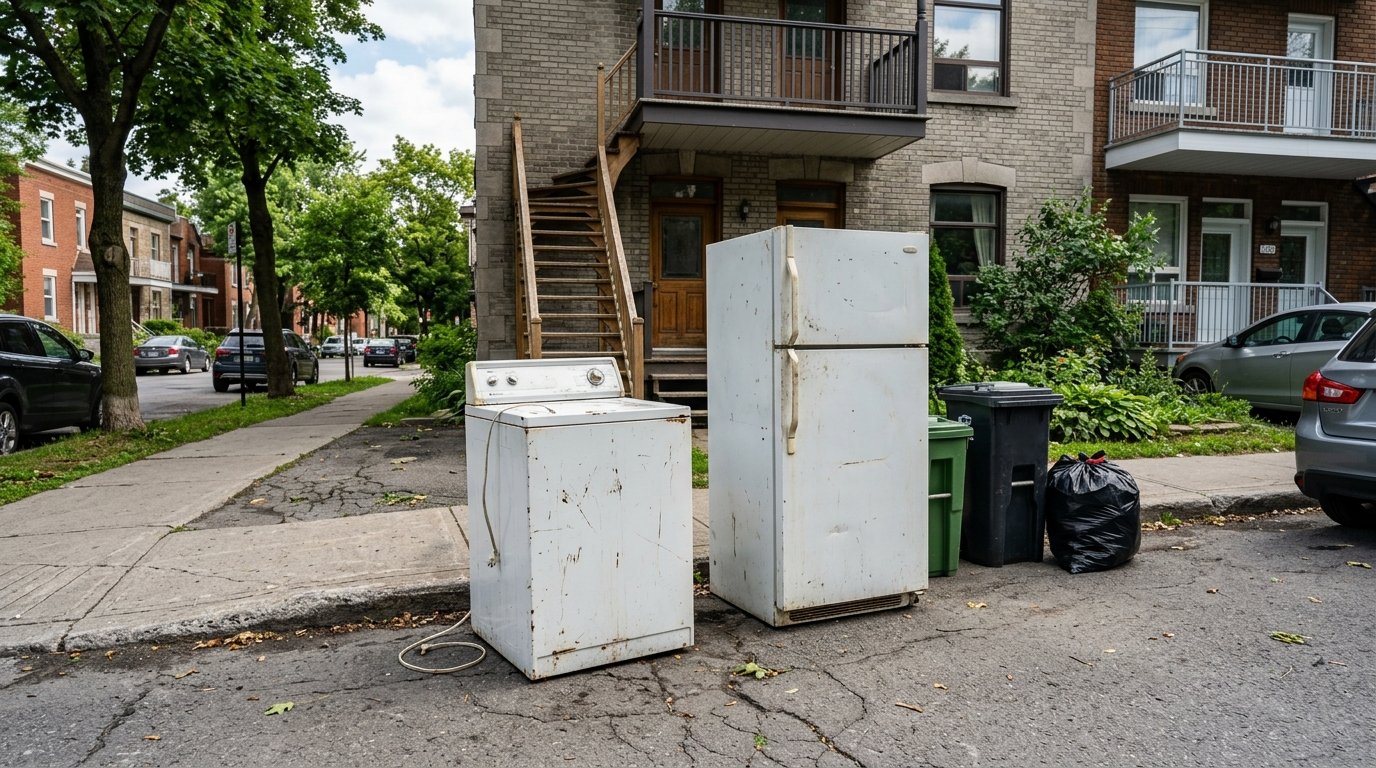
Most household junk — furniture, boxes, general clutter — can go out with bulky-item pickup or a straightforward donation run. Appliances are a different category, and Montreal treats them differently for good reason. Refrigerators, freezers, dehumidifiers, and window air conditioners all contain refrigerant gas that's regulated under provincial and federal environmental rules. It can't just be crushed or landfilled with the refrigerant still inside — it has to be recovered by someone certified to do it, which is why you'll rarely see a fridge simply sitting at the curb on a normal bulky-pickup day without a sticker or tag confirming it's been drained.
Washers, dryers, dishwashers, and stoves don't have refrigerant, but they bring their own headaches: they're heavy (a washer with a concrete counterweight can run well over 200 lbs), often plumbed or wired in place, and typically located in a basement or a kitchen corner that wasn't designed with appliance removal in mind. None of that makes them impossible to move — it just means the "just drag it to the curb" plan that works for a broken chair doesn't really apply here.
If you're clearing out a full kitchen or basement rather than a single unit, it's worth reading this alongside our broader residential junk removal page, since a mixed load (appliances plus general clutter) is usually priced and picked up together rather than as separate calls.
If you're buying a new fridge or washer, many Montreal retailers will haul the old one away with delivery — usually free, but only for the unit being replaced, and only if it's accessible (no basement stairs the delivery crew wasn't expecting).
Montreal and Laval ecocentres accept appliances for free or low cost, refrigerant handled on-site. The catch is transport — you need a vehicle that can actually carry a fridge, and most people don't have a truck sitting around.
Some boroughs will collect appliances on scheduled bulky-item days, but rules on refrigerant tagging vary and pickup dates are infrequent — often just a few times a year per zone.
The most flexible option when you have more than one unit, no truck, a basement location, or just want it gone this week rather than waiting for the next scheduled date.
| Load | Typical example | Price range |
|---|---|---|
| Single appliance | One fridge, washer, dryer, or stove | 80$ – 150$ |
| Two to three appliances | Kitchen renovation set (fridge + stove + dishwasher) | 150$ – 300$ |
| Full basement or kitchen | Multiple old appliances plus surrounding clutter | 300$ – 600$ |
Prices apply across Montreal, Laval, and the South Shore, confirmed by phone based on unit count, access, and whether refrigerant recovery applies before we come out.
A quick note on why the price range moves: it's rarely about the appliance itself and almost always about access. A fridge on a ground-floor kitchen with a clear path to the door is a quick job. That same fridge down a basement staircase, or up three flights in a walk-up with a tight turn on the landing, takes real time and sometimes a second crew member — and that's reflected honestly in the quote, not sprung on you after the fact.
Contain refrigerant, need proper recovery before recycling. Heaviest and most awkward of the common categories — two-person carry is standard, especially on stairs.
No refrigerant concern, but washers are dense and heavy from the concrete counterweight. Often plumbed or vented in place — worth disconnecting water lines and dryer vents before pickup if you're comfortable doing so.
Gas stoves need the line safely capped before removal — if you're not sure this has been done, mention it when you book so we can plan around it. Dishwashers are usually straightforward once disconnected from under-counter plumbing.
Also contain refrigerant like fridges, though in smaller quantities. Common in older Montreal apartments without central air — end-of-season is when we see the most calls for these.
Smaller refrigerant-containing units, often forgotten in a basement corner until a cleanout uncovers three or four of them at once.
No refrigerant, easy to bundle in with a larger pickup rather than booking separately — these rarely justify a dedicated call on their own.
One question we get a lot: does it matter whether the appliance still works? It does, but maybe not the way you'd expect. A fridge or washer that still runs but is simply outdated or the wrong size for a renovated kitchen has real resale or donation value, so we set those aside separately rather than sending them straight into the recycling stream — a working appliance helping someone else out is a better outcome than scrapping it purely for parts. A unit that no longer starts, has a cracked drum, or shows visible rust through the housing generally isn't worth the effort of reselling and goes straight to proper recycling instead. Telling us upfront whether the appliance still functions helps us plan the right outcome for it rather than defaulting to the same handling for every piece.
Kitchen renovations are one of the most common reasons we get called for appliance removal. The pattern is predictable: the new appliances are ordered and on their way, but the old fridge, stove, and dishwasher need to be out before the installers can start work, sometimes with only a few days' notice once the renovation schedule firms up. Retailer haul-away can work here if you're buying replacements from the same store, but it only covers the unit being swapped one-for-one — if you're also getting rid of a second fridge from the basement, or upgrading a dishwasher you weren't planning to replace through that retailer, you're on your own for those.
Basement finishing projects surface a different pattern — old appliances that got moved downstairs "temporarily" years ago (a fridge for extra beverage storage, a chest freezer, an old washer kept as backup) and never left. These tend to get grouped into a single larger pickup once the basement project actually starts, alongside general construction debris. If your renovation is also generating drywall, flooring, or cabinet demolition waste, that's a separate stream from appliances and belongs with our construction debris removal service rather than the appliance rate — let us know the mix when you book so we quote it correctly.
Appliances are, materially speaking, one of the most recyclable things in a home. Once refrigerant is safely recovered from units that have it, the shells are almost entirely steel and other metals that scrap recyclers want — this isn't charity, there's real commercial value in appliance steel, which is part of why appliance recycling infrastructure is well established compared to, say, mattress recycling. Compressors, motors, and wiring get separated out for their own recovery streams, and what's left after all recoverable material is pulled is a small fraction of the original unit.
This is also why proper refrigerant handling matters beyond just following the rule — refrigerant released into the atmosphere is a meaningfully worse environmental outcome than almost anything else in a typical household cleanout, which is why we treat it as a non-negotiable step rather than an optional add-on.
If a lease ends and the new tenant doesn't want the old fridge or stove, it needs to be out before handover — this pairs well with a broader moving cleanout, covered in our Decluttering and Minimalism guide if you're clearing more than just the appliances.
A very common call — an outgoing appliance needs to go before a new tenant moves in, often on a tight multi-unit turnover schedule. We can coordinate multiple units in one building on the same visit.
Older appliances from an estate cleanout, sometimes decades old and no longer efficient or safe to keep running, get picked up alongside the rest of the home's contents rather than as a separate job.
Cafés, salons, and small offices replacing a commercial fridge or dishwasher fall under our commercial waste removal service — our Per-Load or Monthly Billing guide explains how pricing works for recurring business needs versus a one-off pickup.
You don't need to do anything to prepare beyond clearing a path — we handle the disconnecting and moving. That said, a few small steps make the visit faster: if you're comfortable doing it safely, unplugging the unit and shutting off water lines to a washer or dishwasher ahead of time saves a few minutes. For a gas stove, confirming the gas line has already been capped by a technician (standard practice before any stove removal) avoids any delay on pickup day. And if the appliance is in a spot with limited light — many basements qualify — having a lamp or the room's light on helps our crew move safely on stairs.
None of this is required. If you'd rather leave everything exactly as it is and let us handle the disconnection, that's completely normal too — just mention it when you book so we bring the right crew size for the job.
The single biggest mistake we see is underestimating the weight and awkwardness of the job and trying to handle it solo. A refrigerator isn't just heavy — it's top-heavy and bulky, which makes it genuinely dangerous to move down a narrow Montreal staircase alone. Every year we get calls after someone's already tried and either hurt their back or gouged a wall trying to squeeze a fridge around a landing turn. It's not a job that scales down safely to one person, regardless of how strong you are.
The second mistake is assuming municipal bulky pickup will take a fridge just because it took the sofa last time. Bulky-item collection rules genuinely vary by category, and refrigerant-containing appliances are treated differently almost everywhere in the province because of the environmental regulation around refrigerant recovery. Calling 311 or checking your borough's specific appliance rules before setting one out avoids the scenario where it just sits at the curb, untouched, for a week.
The third is holding onto a broken appliance "in case it gets fixed," especially in a basement, for months or years. Appliance repair economics rarely favor an older unit once a major component fails — a repair estimate on a ten-year-old washer often costs more than a big chunk of a new one — and the appliance just occupies space and collects other clutter around it in the meantime. If a technician has already quoted a repair that isn't worth it, that's usually the moment to book the pickup rather than let it linger.
The fourth is not accounting for gas lines. If you have a gas stove, it absolutely needs the line capped by a qualified technician before anyone attempts to move it — this isn't optional and it isn't something a junk removal crew can do on-site. If you're not sure whether this step has happened, ask your gas provider or a plumber before booking the pickup, not after.
Appliance disposal calls often come paired with a replacement decision, so it's worth touching on briefly. Appliances built more than a decade or two ago are typically far less energy-efficient than current models — a fridge from the 2000s can use meaningfully more electricity annually than a comparable new unit, and that gap compounds every month it keeps running. For appliances used constantly, like a primary fridge, the energy savings from replacing an aging unit can offset a real portion of the purchase cost over its lifespan, on top of avoiding a surprise breakdown.
That calculus is less clear-cut for appliances used occasionally, like a chest freezer that only runs seasonally, where the cost of replacement may not be justified purely on efficiency grounds. Either way, once the decision is made, disposal is the same process regardless of why the old unit is going — sorted for recyclable metal, with refrigerant recovered properly if the unit has any.
Property owners and managers with multiple rental units often deal with appliance turnover on a completely different scale than a single household — several units' fridges and stoves reaching end of life around the same time, or a full building renovation replacing every kitchen at once. Booking these as a single coordinated visit, rather than a separate call per unit, is almost always both cheaper and less disruptive to tenants, since our crew can move through a building floor by floor instead of scheduling multiple separate trips.
This also applies to short-term rental operators and small landlords managing a handful of units across different neighbourhoods — a mixed run through, say, a building in Chomedey and another in Rosemont can often be scheduled on the same day if given enough notice. If appliance turnover is a recurring part of managing your properties rather than a one-off, our Per-Load or Monthly Billing guide covers how ongoing arrangements can work out more predictably than booking each pickup individually.
To give you an accurate range on the phone, it helps to know roughly: how many appliances, which types (fridge and AC units matter most for refrigerant), and where they're located — main floor, basement, or which floor of a walk-up. If a gas stove is involved, let us know whether the line has already been capped. None of this needs to be exact; a rough description is enough for a first estimate, and we confirm the final number once we see the actual job.
It's also worth mentioning if the appliances are part of a bigger cleanout — a basement being cleared out entirely, a kitchen gutted for renovation, or a full apartment turnover — since combining appliances with general clutter into one visit is almost always more cost-effective than booking them separately.
We handle appliance pickups island-wide — Côte-des-Neiges–NDG, Rosemont, Villeray–Saint-Michel, Hochelaga-Maisonneuve, and the Southwest — plus Laval neighbourhoods like Chomedey, Duvernay, and Sainte-Rose, along with suburbs including Candiac, Boisbriand, and DDO. Check the full service area list for your specific municipality.
Appliance disposal has a noticeable seasonal rhythm here. Late spring into early summer sees a jump tied to the general moving-season churn — outgoing tenants leaving appliances, incoming tenants requesting swaps, and landlords doing turnover work before July 1st. Early fall brings a second wave as window AC units get pulled for the season and people finally deal with the unit that died back in July but got ignored during the heat. And post-holidays in January is when a lot of kitchen renovations that were planned "for the new year" actually kick off, bringing another cluster of stove and dishwasher removals.
None of this means you're stuck waiting for the "right" season — we run pickups year-round — but if you have some flexibility, booking outside these peak windows can mean a slightly faster turnaround since crews aren't stacked with moving-season or renovation-season volume.
Most Montreal boroughs will not collect fridges, freezers, or air conditioners through regular bulky-item pickup because of refrigerant gas — they need to go to an ecocentre or be picked up by a service that handles refrigerant recovery properly.
Many will, but only when you're buying a new replacement of the same type, and only for the specific unit being replaced — it won't cover a second old appliance sitting in your basement, and delivery crews often skip units in hard-to-access spots.
A single appliance typically runs 80$-150$, two to three appliances together run 150$-300$, and a full basement or kitchen's worth of old units runs 300$-600$, depending on access and whether refrigerant recovery is needed.
Sometimes a small recovery fee applies since refrigerant has to be properly extracted before recycling, per provincial regulation. We'll tell you upfront if it applies to your unit rather than surprising you on site.
Appliances are largely steel and other recoverable metals, which is why they're one of the most recyclable categories of household junk — scrap metal recyclers process the shells once refrigerant and other fluids are safely removed.
Yes, that's most of what we do. Basement stairs, narrow triplex staircases, and tight kitchen doorways are normal in Montreal housing and our crews handle appliance-specific weight and awkward shapes routinely.
Planning a pickup? See all of our service areas, including Montréal-Nord and Saint-Léonard. Related reading: 1-800-GOT-JUNK vs Good Bye Junk: Montreal Pricing and Service Comparison and 5 Ways to Get Rid of Old Furniture in Montreal, Compared.
Call for a price range in minutes, or reach out through the contact form to schedule your pickup.
📞 (514) 295-2123From $150, same-day pickup often available in Montreal, Laval, the North Shore and the South Shore.
GoodBye Junk Montréal
Montreal, QC, Canada
Call nowFree quoteBook onlineAbout us