City bulky-item pickup, donating to a charity, selling online, the ecocentre, or junk removal: we tested, compared, and priced out every one of these options so you don't lose your Saturday to a couch stuck in the stairwell.
We come pick up your old furniture anywhere in Montreal, Laval, or the South Shore — a price estimate over the phone before we ever show up.
Call now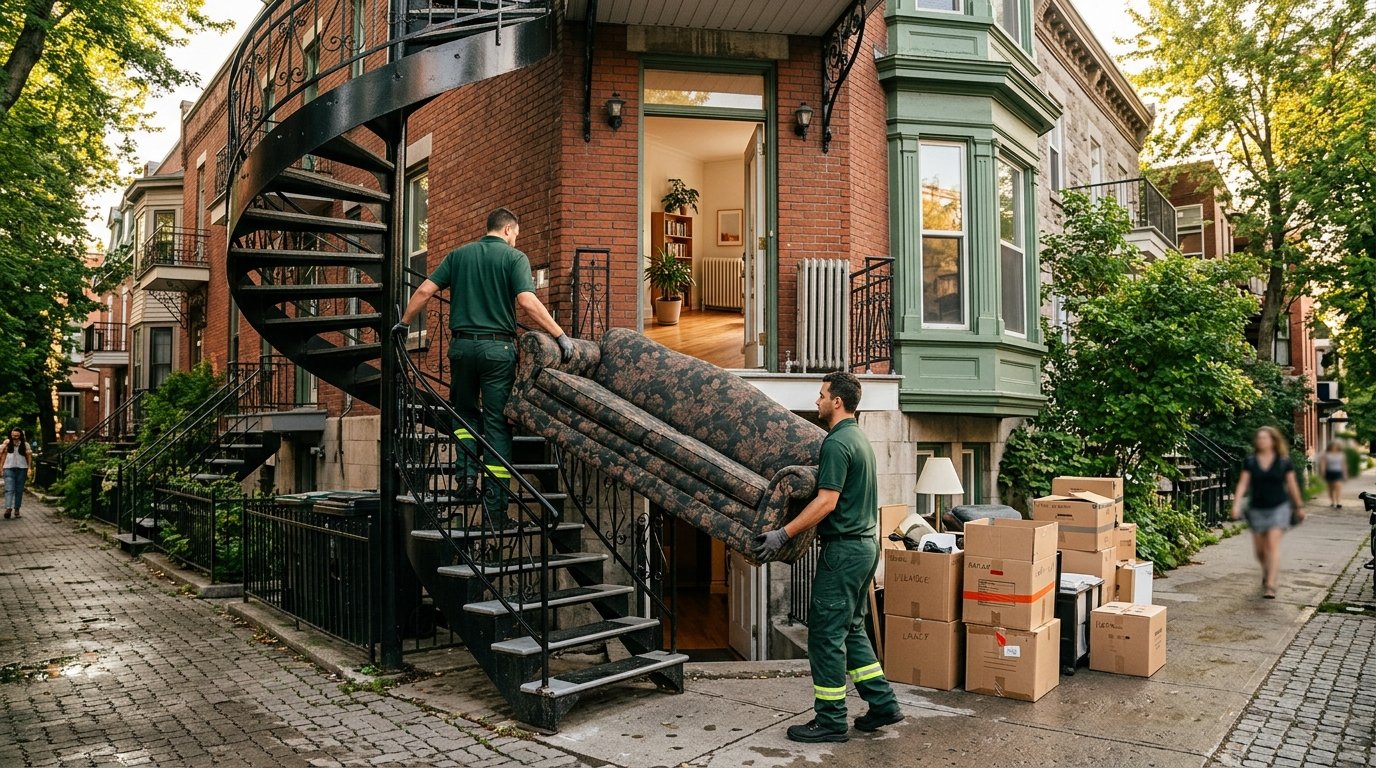
It always starts the same way. You buy a new sofa, or you finally clear out the basement, or a tenant moves out leaving a busted old futon behind — and then the question hits: what do you actually do with the old one? In Montreal, contrary to what you might assume, there isn't one obvious right answer. There are five, each with its own rules, its own timeline, and its own way of eating your afternoon.
We wrote this guide because we see it constantly — people who lost a full afternoon, sometimes an entire weekend, trying a method that just didn't fit their situation. Someone who hoped to sell an old mattress on Marketplace and, three weeks later, still has the mattress and zero serious messages. Someone else who put a sofa out on the curb the wrong week and got hit with an illegal dumping notice. And someone who loaded up the car for a trip to the ecocentre, only to find a one-hour lineup on a Saturday morning.
So we took the five most common ways Montrealers get rid of old furniture and compared them honestly — real cost, real timeline, physical effort required, and what actually happens to the piece once it's gone. We obviously include our own residential junk removal service in the list, because that's our business, but we're not going to pretend it's always the best option — for one small piece in good shape, it often isn't, and we say so plainly further down.
This is the option most Montrealers know first, because it costs nothing and it's built into the city's regular services. Every Montreal borough (and every suburb like Laval) runs its own bulky-item collection, sometimes called "encombrants" pickup, generally a few times a year — often a Sunday evening before a regular Monday pickup, with dates that vary from one borough to the next.
The idea is simple on paper: you put your old furniture, appliances, and other large items out at the curb the night before the scheduled date, and a city crew comes to collect them. In practice, it's an option that demands more planning than people expect.
First, the calendar isn't the same everywhere. A Plateau-Mont-Royal resident and a Rosemont–La Petite-Patrie resident don't share the same bulky-item pickup dates, even though they live ten minutes apart. You have to check the specific calendar for your own borough — on the city's website or in the paper collection calendar mailed out by the municipality — before you put anything out.
Second, setting furniture out outside the scheduled dates isn't a minor detail you can shrug off. It's treated as illegal dumping on public property, and it can carry a fine. We've had more than one client call us after receiving a notice from the city for exactly this reason — the couch didn't move for a week because the pickup date had been noted wrong.
Third, there's an implicit limit on what actually gets taken. Large appliances containing freon, mattresses in excessive quantity, or items that need special disassembly can get refused or simply left behind by the collection crew, which hands you back the original problem — plus the added embarrassment of an old piece of furniture sitting in front of your building for potentially several more days.
City bulky-item pickup is great if your own timeline lines up with the city's — you're clearing out a place three weeks before the scheduled pickup date, you're not in a rush, and you have outdoor space or an entryway where the furniture can wait without bothering the neighbours. It's free, it requires no phone calls, and for a lot of households timing their spring or fall cleanout around these dates, it's more than enough.
It's a much worse fit if you're on a tight deadline — a real estate sale closing in two weeks, a new lease starting, a tenant moving out whose unit needs to be empty before the next one moves in. In those cases, waiting for the next city pickup, which can be months away, simply isn't realistic. That's where a service like ours, with a 24-48h urgent option, becomes relevant.
Donating a piece that's still in decent shape rather than tossing it is almost always the best option environmentally, and Greater Montreal has a solid network of organizations that take secondhand furniture: neighbourhood resource centres, community counters, mutual-aid groups for newly arrived families, and larger organizations with drop-off points scattered across the city.
The problem isn't willingness to donate. Most people would rather give than throw out, if it were easy. The problem is logistics — and that's where donation gets noticeably less simple than it looks on paper.
The first roadblock is transportation. A lot of charities have fixed drop-off points but no home pickup service, or a pickup service limited to certain areas with multi-week waits for an appointment. If you don't have a vehicle large enough to move a sofa or a dresser, this option closes fast.
The second is the piece's condition. Most charities have fairly strict acceptance criteria — no stains, no tears, no odour, often no mattresses at all for hygiene and regulatory reasons. A piece with ten years of solid service that's starting to show its age can get turned away on the spot, leaving you to haul it back home or scramble for another solution the same day.
The third is volume. Donating one or two pieces is easy to coordinate. Donating the entire contents of an apartment — which happens often during an estate cleanout — quickly exceeds what most local charities can take in a single visit, and you end up making multiple trips or combining donation with another method for whatever's left.
Donation really shines for one or two pieces in very good shape, when you have a vehicle or a friend with one, and a bit of flexibility in your timeline. It's also the most emotionally satisfying option — knowing a family will actually use your old kitchen table instead of seeing it end up at the curb is often worth the small extra effort.
That said, if you're clearing out an entire unit, if the furniture is in average or worse condition, or if you simply don't have time to coordinate appointments and drives, it's not a contradiction to go through a professional service that also prioritizes donation. At our end, every job starts with the same instinct: whatever can be donated is, before recycling or landfill is even on the table. The difference is we handle finding the right recipient organization ourselves, so it never becomes your project to coordinate five phone calls.
Selling old furniture online has exploded in popularity, and for good reason: unlike donation, it can actually put a little money in your pocket, and unlike city pickup, it doesn't depend on any fixed schedule. Facebook Marketplace in particular has become, for a lot of Montrealers, the first move for any piece that's still desirable.
The catch is that "selling online" hides a reality that varies wildly depending on what you're trying to sell. A Scandinavian-style dining table in good condition in the Plateau might sell in a few hours. An old futon that's been serving a Saint-Léonard basement for twelve years might sit online for months without a single serious message, despite a price already slashed to $20.
The part people underestimate most is the time invested. Taking decent photos, writing an honest description, answering messages (a good chunk of them "still available?" that go nowhere), negotiating the price, coordinating a pickup time that works for both sides, and sometimes getting stood up by a buyer who never shows. For a modest-value piece — say, $20 to $75 — the time invested often ends up worth more than the amount received, once you calculate it in dollars per hour.
There's also the safety and logistics angle to weigh: letting a stranger into your home or coordinating a meetup in a building lobby, handling transport if the buyer doesn't have a suitable vehicle (which often leads to last-minute cancellations once the buyer realizes the piece won't fit in their car), and sometimes negotiating a price well below what was originally listed once the buyer is standing right there — an unfortunately common tactic on these platforms.
Selling online is great for good-quality furniture, sought-after styles, or a recognized brand — think recent IKEA in good shape, vintage pieces, appliances still under warranty. If you're not in a rush and you enjoy the little back-and-forth of negotiating, it can be both profitable and satisfying.
It's a poor fit if you're pressed for time, if the piece is modest in value, or if you're clearing out several rooms at once and have no interest in juggling ten parallel conversations with potential buyers. A lot of our clients call us precisely after trying Marketplace for two or three weeks without success — at that point, the time lost has far outpaced what a junk removal service would have cost from the start.
Greater Montreal runs several municipal ecocentres spread across different sectors, where residents can bring in residual materials themselves, including furniture, in limited quantity and generally free for residents (sometimes with fees or volume caps for non-residents or beyond a certain number of visits). It's the ultimate "I'll handle it myself" option.
First, you need a vehicle capable of hauling the piece — which immediately rules out a good chunk of Montreal households who don't own a car or only have a small city car. Renting a van for the occasion adds a cost that doesn't always factor into the "it's free at the ecocentre" math.
Then there's the lineup factor. On weekends, especially in spring during seasonal cleanup season and in fall during moving season, Montreal ecocentres can have 30-to-60-minute lineups, sometimes longer. It's not unusual to wait in line, arrive at the unloading dock, and have to haul the piece out of your vehicle and carry it to the right container yourself — no small task for a three-seat sofa or an old queen mattress, alone.
Finally, every ecocentre has its own hours and sometimes its own restrictions on quantities or types of material accepted on a given day. It's worth checking before loading up the vehicle, rather than making the round trip only to get turned away on-site.
The ecocentre is perfect if you already have a vehicle big enough, some free time on a weekday (to dodge the weekend lines), and a modest amount to haul — one or two pieces, not the full contents of a unit. It's also a good option to combine with a bigger cleanup: if you're clearing a garage and already have several loads to bring to the ecocentre anyway, tacking on an old piece of furniture doesn't cost much extra effort.
It's noticeably less practical for a full residential cleanout, difficult access (try carrying a sofa down three flights with no elevator, alone, then loading it into a vehicle), or a situation where time is tight. Our article on donation, recycling, and landfill during a cleanout digs deeper into where materials actually end up once sorted, whether you do it yourself at the ecocentre or through a professional service.
This is where we come in, so we'll try to be as honest as possible instead of just pitching our own service. A residential junk removal service like ours means calling, describing what you've got, getting a price range, then setting an appointment where a crew comes to take it all away — often same-day or within 24-48 hours if needed.
It's the only option that combines speed, zero physical effort on your part, and handling large volumes in a single visit. You don't have to wait for a city calendar, coordinate with a charity, manage messages from online buyers, or load and unload a vehicle yourself. For someone with difficult access — a third-floor Plateau triplex with no elevator, one of Montreal's typical spiral exterior staircases — it's often the only realistic option that doesn't involve hurting your back or begging three friends for help.
For a cleanout ahead of a real estate sale, an estate, or a tight lease deadline, where time matters more than a few dollars saved, it's almost always the option that makes the most sense. We also offer a 24-48h urgent service for genuinely pressing situations.
If you have a single piece in excellent condition, time on your side, and the appetite to try your luck on Marketplace or coordinate a donation, you probably don't need to pay for a full service. We'd rather be upfront about that than push everyone toward the same solution — a ten-minute call is often enough for us to say frankly, "in your case, it might be worth trying Marketplace first."
What we notice most often, though, is that the people who call us have already tried — city pickup didn't land at the right time, nobody responded on Marketplace after two weeks, or the charity they contacted couldn't book an appointment for a month. At that point, junk removal stops being a luxury expense and becomes a way to get your time back and put the problem to bed for good.
| Option | Typical cost | Typical timeline | Physical effort | Best for |
|---|---|---|---|---|
| City bulky-item pickup | Free | Depends on the calendar — sometimes months of waiting | You put the piece out yourself | A cleanout planned well in advance, no urgency |
| Donating to a charity | Free | Immediate to a few weeks, depending on availability | Transport is on you (except rare pickup) | 1-2 pieces in very good condition |
| Selling online (Marketplace, Kijiji) | Negative (you receive money) but high time invested | A few hours to several weeks, highly variable | You handle transport and coordination | Desirable, quality furniture, if you're not in a rush |
| Ecocentre (yourself) | Free for residents (volume limits) | As fast as your next free slot | High — transport, lineup, unloading | Small volume, vehicle already available |
| Professional junk removal | $150 – $1,500+ depending on volume | Often same-day or 24-48h | None — the crew handles it all | Large volume, difficult access, tight deadline |
Estimates based on typical volumes we see across Greater Montreal in 2026. City pickup and donation timelines vary by borough and organization — always check the exact dates before planning around them.
Check your borough's bulky-item pickup calendar — free and zero coordination effort if your timeline can wait.
Contact a local charity first. For one or two pieces in good shape, it's the most satisfying and often quickest route.
Marketplace or Kijiji, with honest photos and a realistic price from the start to avoid endless negotiating.
The nearest ecocentre, avoiding spring and fall Saturday mornings if you can.
A residential junk removal service handles it all in one appointment, often within 24-48h.
For an estate cleanout or a full unit, combining options 2 through 4 quickly turns into a full-time project — a complete service is often the more realistic choice.
After hundreds of residential cleanouts across Greater Montreal, we've noticed that most people don't pick one method and stick with it — they start with one option, hit a snag, then try another. Here are three typical journeys.
Someone lists an old bedroom set online, hoping for $150. After two weeks and a dozen "still available?" messages that go nowhere, the deadline to vacate the apartment gets close. The price drops, drops again, and eventually the person pays for junk removal anyway — just two weeks later than if they'd compared the options on day one. The lesson: honestly assess, from day one, whether your timeline can actually afford to wait on an online sale.
A tenant moves out, puts their old furniture on the curb thinking it's the right week, and gets a notice from the city a few days later because the real pickup date was actually three weeks out. Result: a possible fine, furniture still sitting on the curb, and a new tenant moving in two days later. The lesson: always check the exact calendar before putting anything out, or pick a solution that doesn't depend on the city's schedule.
A family sets out to clear a deceased relative's house, planning to donate most of the furniture. After two visits where only a fraction of the contents got accepted (condition, quantity, or an ineligible category), the family is still stuck with most of the unit to clear, on top of the emotional weight already in play. The lesson: for a full cleanout, particularly an estate, a mix of methods managed by a professional service usually spares a lot of added stress at an already difficult time. We go deeper on this in our article on the weirdest items we've found clearing out houses in Montreal, which shows just how many surprises a full cleanout tends to hold — surprises that none of the first four options handle well on their own.
Not all options are equal once you look at what actually happens to the furniture after your part is done. Here's an honest picture, without pretending any single method is perfect.
Direct donation to a charity is probably the most virtuous option when it works, because the piece moves straight from one household to another with minimal transport and handling in between. The issue isn't environmental impact — it's the logistics, as covered above.
Selling online has an impact similar to pure donation, with the added benefit that the buyer has a financial stake in taking care of the piece once acquired, which often extends its useful life.
City pickup varies a lot depending on what the city does with collected materials afterward — some of it is recovered for reuse by partner organizations, but a good share ends up straight in landfill, without fine sorting, simply because the volume collected in a single night is too large for item-by-item sorting.
The ecocentre generally allows for better sorting than curbside pickup, because materials go into separate containers by type, but reuse still depends on the piece's condition and what resources are available that specific day.
A serious professional junk removal service — and this is a commitment we take seriously on our end — actively sorts before the furniture even leaves your home: whatever can be donated or reused gets flagged right at load-in, rather than being mixed in with everything else and sorted later, if it's sorted at all. That's not automatic with every provider offering this kind of service, so it's worth asking directly how a company handles sorting before booking, whichever business you choose. Our article on donation, recycling, and landfill walks through our own process in detail.
One of the most common blind spots is assuming you need to pick a single one of these five options for an entire project. In reality, the best strategy often combines several methods depending on the piece.
For example, to clear out a full 4½ apartment: the kitchen table in good condition could go on Marketplace for a week with a firm price and a clear deadline ("if it's not sold by Sunday, I'm donating it"). Nobody's buying the stained old couch — donation or ecocentre if it's still acceptable to a charity, otherwise junk removal. Working appliances can go straight to an organization that outfits newly arrived families. And whatever's left — broken items, materials nobody else will take, volume beyond what one vehicle can carry — gets handled in a single call to a junk removal service, which comes to take exactly what's left, nothing more.
This hybrid approach takes a bit more upfront coordination, but it maximizes your odds of recovering a little cash, the satisfaction of knowing you donated the maximum possible, and efficiency in clearing out the rest quickly without burning three weekends on it.
If you'd rather skip all the coordinating and let one crew handle everything — including the donation/recycling sort — that's exactly what a full residential cleanout does in a single visit, without you having to juggle between five different methods.
The five options above don't apply equally to every piece. A dresser and a sectional couch behave very differently once you start comparing routes, so here's a closer look at some of the pieces that generate the most calls and messages.
Large sofas and sectionals are the single most common item we get called about, and it's easy to see why: they're heavy, awkward around corners, and most rental vehicles can barely fit one. A sofa in genuinely good condition, in a trending style, can move on Marketplace reasonably fast — but a worn or stained one almost never sells, no matter how low the price drops, since resale buyers are picky about upholstery. Charities are often stricter on sofas than on hard furniture for the same hygiene reasons, which pushes a lot of used sofas straight to junk removal or the ecocentre. Sectionals in particular are worth measuring before you commit to any route — some don't break down for stairwells the way you'd hope, and that changes which option is even physically possible.
Mattresses are their own category of headache. Many charities won't accept them at all, city bulky-item pickup sometimes caps how many can go out per household per collection, and hauling a queen mattress solo down a spiral staircase is genuinely difficult and a common way people hurt their backs. If you're replacing a mattress, ask the retailer about haul-away first — some include it with delivery — and if that's not available, this is one of the items where a dedicated mattress and box spring removal service tends to be worth the cost purely for the physical effort it saves.
This is the category where donation and online resale work best. Solid wood dressers and bookshelves hold value and interest better than upholstered pieces, they're easier for charities to inspect and accept, and they survive a curb wait better than a mattress would if a pickup date gets missed. If you have several pieces like this from the same room, batching them into one Marketplace listing ("bedroom set, sold together or separately") tends to move faster than five separate posts.
A complete, matching dining set is one of the few furniture categories that regularly sells for real money online, especially solid wood sets or anything from a recognizable brand. Mismatched chairs or a table with visible damage are a much harder sell — buyers looking at dining sets tend to be pickier than buyers looking for a "good enough" bookshelf, since a dining set is usually a centrepiece rather than a background item.
Appliances containing refrigerant (fridges, freezers, some air conditioners) need special handling almost everywhere in Quebec, which rules out plain curbside dumping even on a valid collection date in some boroughs. Retailers will often haul away your old unit for free or a small fee when they deliver a replacement — worth asking every time you buy a new appliance. Our appliance disposal and recycling guide covers the freon rules and what actually happens to these units in more detail.
Post-pandemic home offices have quietly become one of the more common decluttering categories we see, especially as people downsize a spare-room setup back into shared living space. Basic particleboard desks rarely sell for much and are often better donated or recycled outright, while ergonomic chairs and solid wood or metal filing cabinets tend to hold resale value reasonably well if they're still functional.
Whether your old furniture is in Montreal, in Laval, or over on the South Shore, our crew works from the same volume-based price grid, with no hidden markup by neighbourhood. That includes areas like Rosemont, Côte-des-Neiges–NDG, Hochelaga-Mercier, and Villeray–Saint-Michel in Montreal, plus Chomedey and Duvernay in Laval, and North Shore sectors like Rosemère, Boisbriand, and Blainville. You can check the full list of service areas to confirm your exact sector.
A single old couch sitting around seems harmless. But multiplied by thousands of Montreal households every year, the picture gets a lot bigger than it looks — in volume, in wasted money, and in missed chances for reuse. We explored this question in more depth in our article on how much money Montrealers throw away without realizing it every year, which puts into perspective what the individual choice you make about an old piece of furniture adds up to at a citywide scale.
A professional junk removal service is by far the fastest — often same-day or next-day. City bulky-item pickup only runs a few times a year depending on your borough, and selling online can take weeks if nobody replies.
No. Every borough has a specific bulky-item collection schedule, usually a handful of fixed dates a year, and setting furniture out on the wrong week can get you fined for illegal dumping. Check your own borough's exact calendar before putting anything out.
The donation itself is free, but many charities don't offer home pickup, require the piece to be in very good condition, or have multi-week waits for a collection appointment. It isn't always the fastest option even at a $0 price tag.
For a few items — a sofa, a dresser, a mattress — expect roughly $150 to $300 depending on volume and access, with a confirmed appointment instead of a months-long wait like city pickup.
Montreal ecocentres sort part of what comes in for reuse and recycling, but sorting depends on the item's condition and what resources are available on-site that day. A professional junk removal service actively prioritizes donation and reuse before the furniture even leaves your home.
Planning a pickup? See all of our service areas, including Île-Perrot and Vaudreuil-Dorion. Related reading: Moving in Montreal: What to Do With Unwanted Furniture and Belongings and Where to Donate Furniture in Montreal: 8 Organizations That Pick Up.
Call us for a clear estimate — we come pick up your old furniture anywhere in Greater Montreal, often within 24-48h.
📞 (514) 295-2123From $150, same-day pickup often available in Montreal, Laval, the North Shore and the South Shore.
GoodBye Junk Montréal
Montreal, QC, Canada
Call nowFree quoteBook onlineAbout us