Choosing between a bin left on site and a direct pickup changes your price, your timeline, and how you run your job site. Here's how to decide, with real numbers for Montreal, Laval and the South Shore.
Describe your project and we'll recommend a bin or direct pickup with a clear price, no jargon.
Call now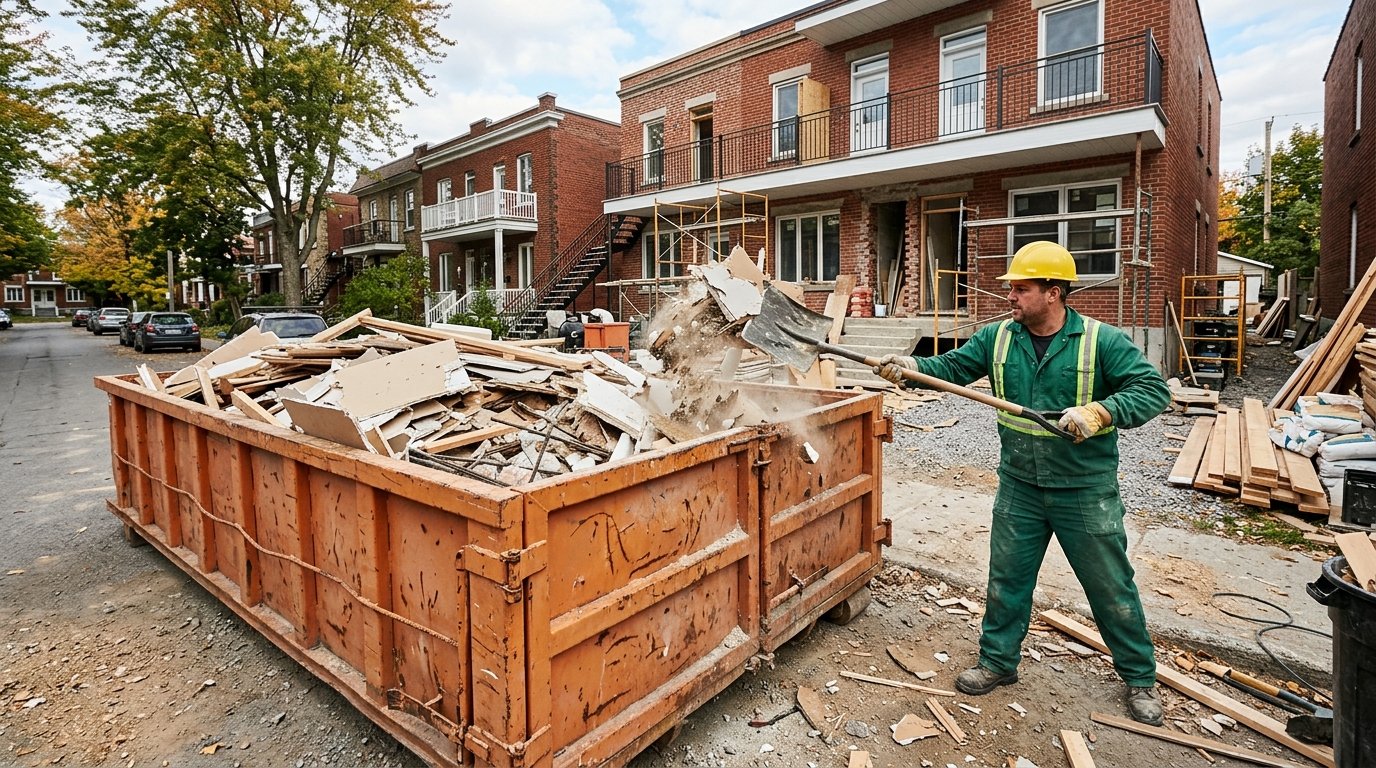
The moment a homeowner or a contractor calls us about a renovation job in Montreal, the first question almost always comes up: "do I need a bin, or can you just come pick it up?" It's a fair question, because the right answer isn't the same for everyone. A bin sitting unused in a driveway for three weeks costs money for nothing. On the flip side, trying to manage a big demolition job with one-off pickups can turn into a logistical headache and end up costing more than expected.
In this article we break down both options — a bin left on site and direct pickup — with real prices, real sizes, and the criteria we actually use ourselves to advise clients on residential and commercial jobs across the Greater Montreal area: Montreal, Laval, the South Shore and North Shore.
If you're starting from a specific project — a kitchen renovation, a basement demolition, a roof job, clearing out a space before a new tenant moves in — the answer becomes pretty clear once you look at volume, job duration, and site access. We'll cover all of it.
A bin is the metal box we drop off at your home or job site, which you fill at your own pace, and which we come pick up once it's full or on the agreed date. It's the classic option for any project that runs longer than a day or two.
The main advantage of a bin is freedom. You don't need to coordinate a pickup every time a pallet of demolished drywall piles up — you toss it as you go, and the bin stays on site until the job is done or the box is full. It's also often the most economical option per cubic yard once the total volume goes beyond what fits in a single truck visit.
The downside: you need the space to receive it, and on narrower streets in Côte-des-Neiges or the Sud-Ouest, parking can become an issue. We cover that more in the permit section below.
Direct pickup means our crew shows up with a truck, loads all the debris in a single visit, and leaves with it. Nothing sits on your property before or after. It's the option we recommend for:
Tearing down a wall, ripping out a floor, swapping cabinets — everything ready to load in a single visit.
Condo buildings, narrow laneways, shared parking — no room to leave a bin for several days.
You want it done today or tomorrow, without managing a multi-day rental.
Direct pickup is often simpler to organize: no bin reservation, no municipal permit to manage, no worrying about whether the box is blocking a parking spot. We show up, load, and go. It's also the ideal option when debris is already piled up on site — for example after a contractor finishes a demolition and you just want it gone fast.
For commercial jobs like a commercial space cleanout before relocating, direct pickup is often preferred because there's no gradual buildup — everything needs to be out at once, quickly.
| Criteria | Bin on site | Direct pickup |
|---|---|---|
| Job duration | Several days to several weeks | One day or less |
| Debris buildup | Gradual, at your own pace | Everything ready in one go |
| Space required | Driveway, yard or dedicated parking | None — truck comes, loads, leaves |
| Municipal permit | Required if placed on public street | Generally none |
| Best for | Kitchen reno, roofing, partial demolition | Small jobs, commercial sites, emergencies |
When in doubt, we can walk through both options over the phone based on your type of project and timeline.
Price transparency is one area where we really stand apart from the competition. National franchises like 1-800-GOT-JUNK don't publish a fixed price list online — every estimate is done on site, which makes it hard for a customer to compare before even calling. At Good Bye Junk, we post our price ranges directly, so you can plan your renovation budget before you pick up the phone.
| Service | Details | Estimated price |
|---|---|---|
| 10-yard bin | Delivery + standard rental + pickup | $400 – $550 |
| 14-yard bin | Delivery + standard rental + pickup | $550 – $750 |
| 20-yard bin | Delivery + standard rental + pickup | $700 – $950 |
| Direct pickup — small load | Bathroom, partial demolition | $250 – $400 |
| Direct pickup — medium load | Full kitchen, flooring, carpet | $450 – $650 |
| Direct pickup — large load | Extensive demolition, large volume | $700 – $900+ |
| Commercial / contractor site | Billed per load or monthly agreement | Custom quote |
Estimated prices for Montreal, Laval and the South Shore. Final price depends on the type of debris (concrete and brick weigh far more than wood), real volume, and site access. We always confirm the range over the phone before dispatching a truck.
For a contractor juggling several job sites at once, a monthly agreement with recurring pickups avoids negotiating a price on every project — similar to what we already offer businesses in our Commercial Waste Management in Montreal: A Guide for Small Businesses, where the logic of predictable volume applies just as well to a recurring job site as to a storefront.
In Montreal as in Laval, municipal rules draw a clear line between where you can place a bin with no formal process, and where a permit becomes necessary.
If the bin stays entirely on your property — driveway, yard, private parking spot — you generally have no paperwork to file with the city. That's the simplest and most common scenario for single-family homes and duplexes with a private driveway.
As soon as the bin encroaches on the street, sidewalk or a public parking spot — common in dense neighbourhoods like Hochelaga-Mercier or Villeray where private driveways are scarce — a temporary occupancy permit for public property is generally required from your borough. Timelines and fees vary by borough, so it's worth checking with your local Accès Montréal office before booking, especially if your project has a fixed start date.
Montreal and several surrounding cities require source separation for certain debris categories — notably wood, metal and concrete — on demolition and renovation projects above a certain scale. This requirement fits into a broader waste management trend that touches job sites and businesses alike. We handle sorting downstream to make life simpler for our clients, but if you want to understand the full set of rules that apply to your project — demolition permits included — we cover that topic in more detail elsewhere on the blog.
Parking is another factor worth weighing: a bin left on the street blocks a spot for several days, which can rub neighbours the wrong way in a dense area. That's often a good reason to prefer direct pickup for projects where space is tight, like in parts of Rosemont or Anjou.
Framing and finish lumber, drywall/gypsum, concrete and brick, metal (piping, trim, framing), asphalt shingles, ceramic and tile, carpet and underlay, windows and doors, removed kitchen cabinets, replaced plumbing fixtures.
Unsealed asbestos, liquid unset paint, chemicals and solvents, oil tanks — these materials require specialized handling. We can point you to the right resource or coordinate a tailored response.
A point that's often underestimated: concrete and brick weigh noticeably more than wood or drywall for the same visible volume. A 10-yard bin filled to the brim with brick can approach legal weight limits for transport, while a bin of the same size filled with framing lumber will be nowhere near that limit. That's why the type of debris — not just the volume — directly affects final price. When you call, mention whether your job involves masonry or concrete demolition: it can change the recommended bin size, even if the volume "looks" small.
Cabinets removed, counter, flooring, a few partitions moved, job spread over two weeks. Recommendation: 14-yard bin on a private driveway, no permit needed. See our page for Chomedey-Laval.
Partitions, drop ceiling, floating floor, a full weekend project. Recommendation: 10-yard bin or direct pickup at the end depending on available space. Details for Duvernay.
Asphalt shingles torn off in one go, a single-day job with a roofing crew. Recommendation: direct pickup at end of day, no box to manage on the roof or in the driveway. Info for Dollard-des-Ormeaux.
Commercial partitions, ceiling, flooring to clear before the next tenant moves in. Recommendation: direct pickup with 24-48h turnaround to meet the lease deadline. See also our commercial waste page and our Sud-Ouest service area.
One day or less → direct pickup. Several days or weeks → bin.
Private driveway available → easy bin. Narrow laneway or condo → direct pickup is often simpler.
Debris generated over days → bin. Everything already demolished and ready → direct pickup.
When in doubt, call us before you book anything. We'd rather steer you toward the cheapest option that actually fits your needs than sell you the biggest size every time.
In the Montreal market, two types of players compete for construction waste removal: big national franchises and small local operators. 1-800-GOT-JUNK, as a national franchise, offers a standardized service but doesn't publish a fixed price list — every job needs an on-site estimate before you know the real cost, which complicates budget planning for a renovation. Smaller local players, on the other hand, tend to have a limited online presence, which makes it hard to compare their services and rates ahead of time.
At Good Bye Junk, we made the opposite choice: publishing our price ranges directly on the site, for Montreal, Laval and the South Shore, so you can compare before you even pick up the phone. We combine that with 24-48h service for tight deadlines, a local crew used to the realities of dense neighbourhoods (laneways, limited parking, walk-up access), and a priority on sorting and recycling over automatic landfilling.
In Montreal, renovation season kicks off in late April and stays busy until mid-November. That has a direct impact on two things: bin availability and municipal permit processing times. Between May and August, boroughs see noticeably more requests for temporary occupancy permits, which can stretch approval time from a few days to more than a week depending on the area. If your job depends on a street bin, it's better to apply as soon as your start date is confirmed rather than waiting until the week before.
Winter brings its own set of constraints: street snow removal can temporarily ban bin parking on certain blocks, and frozen ground sometimes complicates access to sloped lots or unpaved driveways. For winter demolition jobs — pretty common for basement renovations, which suit an indoor project well during the cold months — direct pickup is often simpler than a bin, precisely because there's no extended parking constraint to manage under the snow.
For a general contractor juggling several active job sites at once across Greater Montreal, the bin-vs-pickup question plays out differently. Rather than booking a separate bin for every small job, several of our contractor clients opt for a recurring pickup agreement: our crew comes on a fixed schedule (say, every Friday) across a rotation of job sites, which avoids having several bins sitting — and being billed — at once on sites where volume doesn't justify it yet. We tailor this case by case based on the number of active sites and how they're spread across Montreal, Laval and the South Shore.
One frustration we often hear from clients who've used other services in the past: the impression that everything just ends up in a landfill, no matter how carefully it was sorted on site. At Good Bye Junk, priority goes to reuse and recycling before landfilling. Uncontaminated framing lumber can be turned into wood chips or biomass. Metal — piping, framing, trim — has recovery value and rarely ends up in a landfill anyway. Concrete and brick are crushed and reused as fill material or road base at several waste management facilities across the metro area.
Drywall/gypsum poses a particular challenge: its breakdown in a landfill can generate problematic odours and gases, which is why several sorting facilities require it to be kept separate from other debris. That's one reason source separation — even a basic version, like keeping demolished gypsum in a separate area from wood on site — speeds up downstream processing and reduces disposal fees in many cases.
We apply this same sorting and recovery logic on both construction job sites and recurring commercial contracts — see our commercial waste management guide for small businesses for the version applied to shops and restaurants.
A two-minute call is usually enough to get a reliable price range, as long as you have this information ready:
With these details, we can usually tell you right away whether a bin or direct pickup fits your situation better, and give you a precise price range before a truck ever moves.
A bin makes sense for a job that stretches over several days or weeks, where debris builds up gradually. Direct pickup makes sense for a one-off job where everything is loaded in a single visit, with nothing sitting on your property in between.
Generally between $400 and $550 for a 10-yard bin, $550 to $750 for a 14-yard, and $700 to $950 for a 20-yard, including delivery, a standard rental period, and pickup. Final price depends on the type of debris and how long the bin actually stays on site.
Yes, if the bin sits on public property, a temporary occupancy permit is generally required from your borough. On private property, no permit is usually needed.
Wood, drywall, concrete, brick, metal, asphalt shingles, ceramic tile, carpet, windows and doors. Hazardous materials need specialized handling.
Standard rental usually covers 7 to 10 days. Beyond that, additional daily fees generally apply.
For a small one-time volume, yes. For a job spread over several weeks, a bin usually works out cheaper per cubic yard.
Planning a pickup? See all of our service areas, including Saint-Laurent and Ahuntsic-Cartierville, or learn about our construction debris service. Related reading: Junk Removal Before Selling Your Home: A Pre-Listing Checklist for Montreal and Per-Load or Monthly Billing: Managing Waste for Small Businesses.
Describe your job and we'll recommend the right option with a clear price.
📞 (514) 295-2123From $150, same-day pickup often available in Montreal, Laval, the North Shore and the South Shore.
GoodBye Junk Montréal
Montreal, QC, Canada
Call nowFree quoteBook onlineAbout us