Lease coming to an end, moving to a new space, or shutting the doors for good — here's how to clear a commercial space in Montreal properly, on time, and without leaving recoverable equipment on the curb.
Tell us your key-handover date and the size of the space — we'll give you a price range before we ever show up.
Call now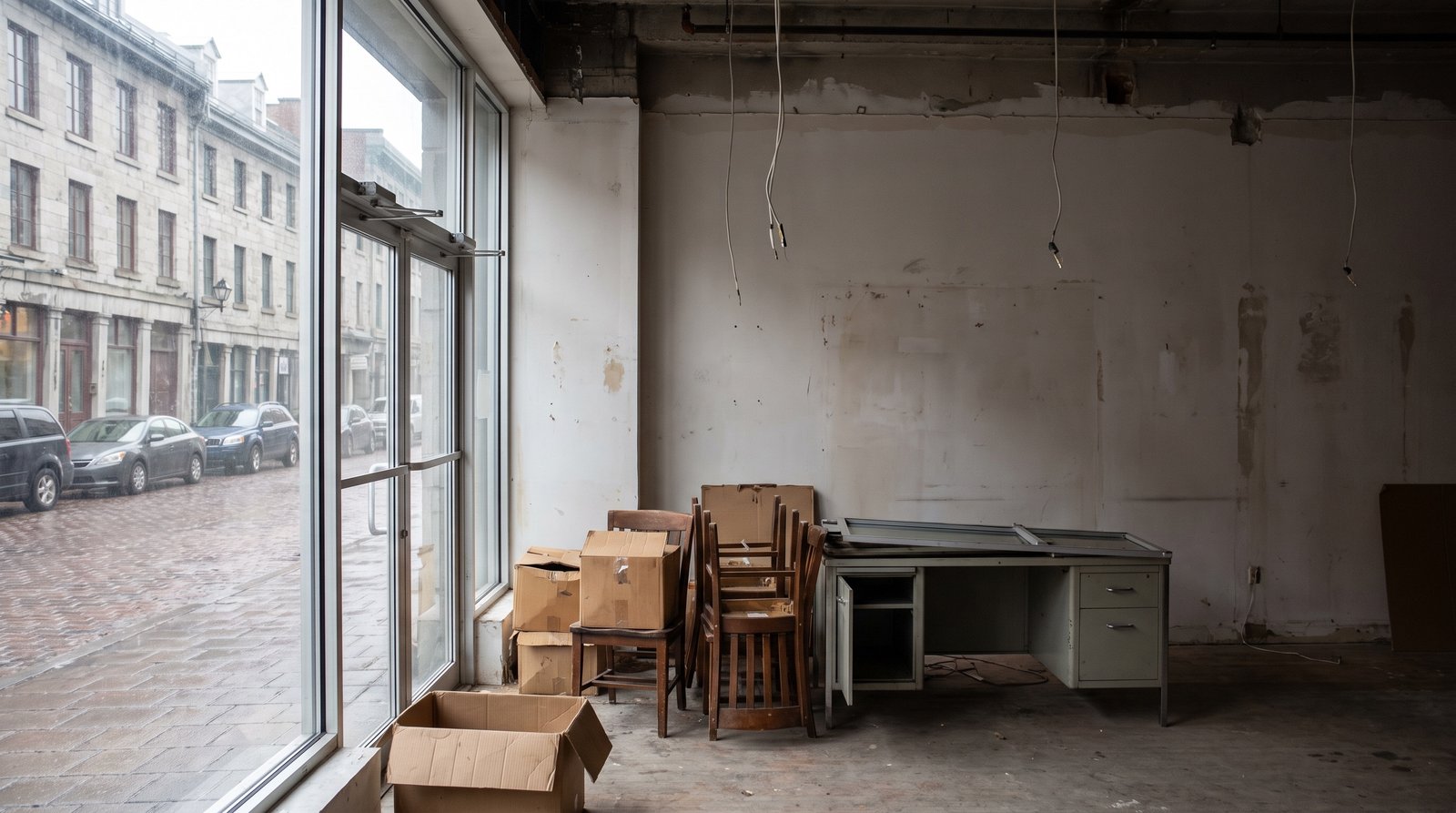
Closing a business or moving to a new space already comes with enough on the plate — the lease, staff, customers to notify, inventory to move or liquidate. The physical cleanout of the space itself tends to land last on the priority list, even though it's the step that actually determines whether you get your deposit back and whether you hit key-handover day without a penalty.
A commercial space empties out differently than a home. There's usually a lot more office furniture, sometimes display fixtures bolted to the wall, specialized equipment depending on the industry (restaurant kitchens, salon stations, office gear), and often files or records that need careful handling before disposal. It's a project that looks more like a coordinated job than a simple pickup, which is exactly why a service built for commercial work gets much better results than a generic hauler.
This guide covers the two most common scenarios — a business closing for good, and a business relocating to a new space — since both share the same need to clear a space fast, but with different priorities. We'll walk through a realistic timeline, average costs by space size, what has to come out to satisfy the lease, and how to avoid losing value on equipment or furniture that's still usable.
Most commercial leases in Montreal include a restoration clause requiring the tenant to return the space to a condition comparable to the start of the lease, sometimes with specific requirements (removing signage, added partitions, installed equipment). Ignoring or underestimating this clause is one of the most common ways to lose part of a security deposit, or worse, end up billed by the landlord for work done after key handover.
In practice, that means a commercial cleanout isn't just about hauling out furniture. It often means removing:
Reading the restoration clause carefully before planning the cleanout avoids nasty surprises. When in doubt, a quick conversation with our team often clarifies what has to go versus what stays, before a date is even set. Some landlords will also do a joint walkthrough before key handover to confirm expectations verbally — not mandatory, but it significantly reduces disputes over the deposit afterward.
Reread the lease, identify what has to be removed, start liquidating sellable inventory.
Book the cleanout, sort what goes to donation, resale, or recycling.
Full cleanout of the space, including furniture, equipment, and excess stock.
Space empty and ready for the landlord's final inspection.
This timeline isn't set in stone — some closures happen with very little notice (bankruptcy, early termination, disaster). In those cases, an urgent 24-48h service is available, but booking earlier always gives more scheduling flexibility and generally a better price, since the crew can plan the visit without compressing the timeline.
| Space size | Example | Indicative price |
|---|---|---|
| Small unit / office | Studio, small office, kiosk | 500$ – 900$ |
| Medium unit | Retail store, standard office | 1000$ – 2000$ |
| Large unit / restaurant | Full kitchen, large store, multi-room space | 2500$+ |
Indicative pricing for Montreal, Laval, and the South Shore, confirmed based on access (elevator, loading dock, parking) and actual volume to remove.
The factor that swings the price the most isn't always square footage — it's access. A unit in a mall basement with a long haul to the loading dock takes more time than a ground-floor space with direct alley access. Mentioning these access details on the first call gets you a much more accurate estimate from the start, with no surprises on cleanout day.
Volume composition matters too. A space filled mostly with light furniture (chairs, tables, boxes) clears faster than one with heavy or fixed equipment — bolted counters, large commercial kitchen gear, added partitions. Giving an honest picture of the contents when requesting a quote, rather than underselling the real volume, avoids gaps between the phone estimate and the confirmed on-site price.
One of the most frustrating parts of a closure or relocation is watching perfectly functional equipment get tossed simply because there wasn't time to sell or donate it. Our approach consistently prioritizes donation and resale before recycling:
Office furniture, functional kitchen equipment, display fixtures in good shape, recent electronics — anything still useful elsewhere is directed to reuse before landfill is even considered.
Connected equipment (electrical, plumbing, ventilation), hazardous materials, or medical waste — we can point you to the right specialized resource if technical disconnection is needed before removal.
For sensitive documents and files, our recommendation is to handle them separately before the general cleanout — dedicated shredding is always preferable to bulk recycling when confidential information is involved.
A good habit before the crew arrives is a quick room-by-room pass sorted into three simple categories: what's heading to the new space (relocation), what can be sold or donated, and what genuinely needs to be removed. That step often takes only an hour or two but speeds up the on-site work considerably, cuts billed time, and avoids accidentally clearing out something that should have been kept or sold.
A closing restaurant kitchen needs particular attention: heavy equipment (ovens, refrigeration, hoods), surfaces that need cleaning to public health standards, and sometimes technical connections like a grease trap that require a specialist to disconnect before full removal. We handle the physical volume — equipment, dining room furniture, surplus — while you coordinate the regulatory side with the right resources.
A closing or relocating office mostly generates furniture (desks, chairs, filing cabinets), electronics at end of life, and paper records. This is generally the simplest scenario to plan, often doable in a single visit if the space isn't too large.
A closing retail store often combines unsold surplus inventory, fixtures bolted to walls or floors, and sometimes exterior signage that needs to come down depending on the lease. Sorting inventory beforehand — liquidation, donation, return to supplier — speeds up cleanout day considerably.
A salon, clinic, or professional office often has mixed needs: specialized furniture (chairs, treatment tables), electronics, and sometimes client files that need confidential handling before disposal. This type of space usually combines several of the issues above — equipment, furniture, and sensitive documents — in a footprint that's often more compact than a standard office.
A permanent closure and a relocation share the same time constraint — clearing the space before key handover — but they don't share the same priorities. For a closure, the goal is removing everything and maximizing donation or resale since nothing will be reused. For a relocation, part of the furniture and equipment follows to the new space, meaning the cleanout only covers surplus, outdated gear, and anything that no longer fits the new location.
If your relocation also involves buildout work at the new space — partitions, flooring, counters — construction debris removal becomes relevant once that work starts, on top of clearing the old space. The two projects often run in parallel and can be scheduled with the same crew to simplify logistics.
For a commercial space cleanout, choosing the right provider matters more than usual because there's little margin for error on the timeline — a badly executed or delayed cleanout can cost real money in lease penalties. Among local options, several competitors are active in the market, but with fairly limited online detail on pricing and specific commercial services.
The criteria that matter most for this kind of project: the ability to hit a fixed, non-negotiable date, experience with commercial specifics (bolted fixtures, heavy equipment, loading access), and clear communication on what's included in the price — especially if the lease demands a precise restoration.
Another often-overlooked criterion is the ability to run a discreet cleanout, without a truck parked in front of the door during business hours or while customers are still around. For a business winding down gradually rather than overnight, being able to schedule the work outside peak hours — early morning, evening, or weekend — helps manage the transition without extra discomfort for remaining customers or staff.
It's also worth asking how a provider prices the job — a flat quote confirmed before work begins is far easier to plan around than an hourly rate that can balloon if access turns out to be trickier than expected, or if the crew finds more volume than described over the phone. A provider willing to walk the space in person, or review photos in detail, before confirming a number is generally a better sign than one quoting purely off square footage.
The physical cleanout is only part of closing or relocating a business — the human side matters just as much. Staff who stay until the end generally appreciate knowing what to expect on cleanout day, especially if some need to help sort their own workspaces or grab personal items before the crew arrives.
On the customer side, a business that communicates its closing or moving date clearly, rather than disappearing without notice, tends to preserve a better long-term relationship — important if the business plans to reopen elsewhere or the owner keeps a presence in the same area under another form. Coordinating cleanout timing with these announcements avoids awkward situations, like customers showing up to an already-empty space.
A lot of Montreal businesses also rent a separate storage space — something like a garage or storage unit — for surplus inventory, seasonal equipment, or archives. This kind of space usually empties out the same way a residential garage does: gradual accumulation over several years, a mix of items to keep and toss, sometimes restricted access. Our guide on garage cleanout in Montreal, where to start and what it costs covers exactly that situation and can be useful if your closure or relocation also involves this kind of attached space.
Planning both cleanouts — the main space and the storage unit — at the same time, with the same crew, generally simplifies logistics and avoids paying for two separate visits that could have been combined.
Montreal's commercial lease cycle has its own rhythm. July 1st, the province's traditional moving day, pulls a huge share of residential leases with it, and a meaningful number of commercial leases run on similar renewal cycles. That means crews get booked up fast in June and early July, and any business closing or relocating during that window should lock in a date well ahead rather than assuming a slot will be available on short notice.
Older commercial buildings in downtown and Old Montreal add their own wrinkle — narrow service elevators, loading docks shared between several tenants, and delivery windows restricted by the city. A crew that knows these buildings avoids unpleasant surprises on cleanout day, unlike a generic service discovering these constraints on-site for the first time. If your space is in one of these older buildings, mention it when booking so the visit can be planned around the real access conditions rather than a generic assumption.
Reread the restoration clause, separate what's heading to the new space, sell off any sellable inventory, flag sensitive documents to handle separately.
Access details (floor, elevator, loading dock), any heavy or connected equipment, non-negotiable deadline, preferred schedule (evening/weekend if needed).
Our coverage areas include downtown, the Sud-Ouest, Hochelaga-Mercier, and the wider Greater Montreal region — useful to know if your relocation means a change of neighbourhood rather than a straight closure.
It also helps to walk the space with this checklist in hand rather than relying on memory alone, especially for a business that's occupied the same unit for several years. Storage rooms, back offices, and anything above a drop ceiling or behind a false wall are the spots most often forgotten until the very last day — and finding surprise volume on cleanout day is the single most common reason a quoted price shifts once the crew is on-site. A five-minute walkthrough with the checklist a week or two before the crew arrives, rather than the morning of, gives enough time to flag anything unusual — an old safe, built-in shelving, or equipment nobody remembers installing — so it can be priced accurately instead of becoming a last-minute complication.
Utilities are another item that's easy to forget on a cleanout checklist but expensive to overlook. Confirming with the landlord or property manager when power, water, and HVAC need to stay active for the crew to work safely — versus when they're scheduled to be cut — avoids a scenario where the cleanout gets scheduled for a date when the space is already without electricity for the elevator or lighting. This is a small coordination detail, but it's one that falls through the cracks often enough during a stressful closure that it's worth confirming explicitly rather than assuming someone else has it handled.
Booking the cleanout just days before key handover reduces available options and can cost more than planning ahead.
Missing a detail in the restoration clause can lead to unexpected charges billed by the landlord after key handover.
Functional equipment or furniture tossed too quickly is an avoidable financial loss — a quick sort before cleanout often recovers some of that value.
Client files, financial documents, or confidential information mixed into general recycling is an avoidable risk with a little planning.
A less obvious mistake is failing to confirm who's responsible for what before cleanout day — landlord, tenant, or a subtenant, in cases where part of the space was sublet. Clarifying this early, ideally in writing, avoids disputes about scope right when there's the least time to sort them out.
Whether it's a permanent closure or a relocation, a well-planned commercial space cleanout is won in the weeks leading up to key handover, not in the last few days. Rereading the lease, sorting recoverable inventory and equipment, and booking the crew early enough for scheduling flexibility make all the difference between a smooth transition and a race against the clock.
If your date is approaching and you don't have a plan yet, a quick estimate request tells you in a few minutes what it means for your space, your timeline, and your budget. Whether you're closing for good or moving to a bigger space elsewhere in Montreal or Laval, the key is treating the cleanout as a planned step in the transition calendar, not a last-minute task squeezed into the final days before handover.
And if the bigger picture involves a full move — not just the old space but new furniture, packing supplies, and a household in transition alongside the business — it's worth remembering that unwanted belongings from a move follow the same donate-first, recycle-second logic as a commercial cleanout. The same crew that clears your old office or storefront can just as easily handle the residential side of a move happening at the same time.
A small office or retail unit usually runs 500$-900$, a medium space between 1000$-2000$, and a large space or full restaurant kitchen can exceed 2500$.
Ideally 2 to 4 weeks before key handover. Urgent 24-48h service is available for tighter timelines.
Anything still in good condition is prioritized for donation or resale before recycling.
Yes, including kitchen equipment and dining room furniture. For connections like a grease trap, we can point you to the right specialist.
The full cleanout is part of the job. Repair work like painting or flooring is organized separately according to the lease.
Yes, we work around your business's schedule, including evenings and weekends.
Planning a pickup? See all of our service areas, including Kirkland and Beaconsfield. Related reading: Condo Cleanout in Montreal: Access Challenges and Solutions and 24-48h Emergency Cleanout in Montreal and Laval: How It Works.
Call us for a clear price range, built around your timeline.
📞 (514) 295-2123From $150, same-day pickup often available in Montreal, Laval, the North Shore and the South Shore.
GoodBye Junk Montréal
Montreal, QC, Canada
Call nowFree quoteBook onlineAbout us