A burst pipe, an overflowing washing machine, a kitchen fire — the first 48 hours decide how much of your home you keep. Here's exactly what to do, in what order, and what an emergency cleanout in Montreal actually costs.
Call us and describe what happened. We'll tell you honestly whether it's a cleanout situation or whether you need a remediation company first.
Call now: (514) 295-2123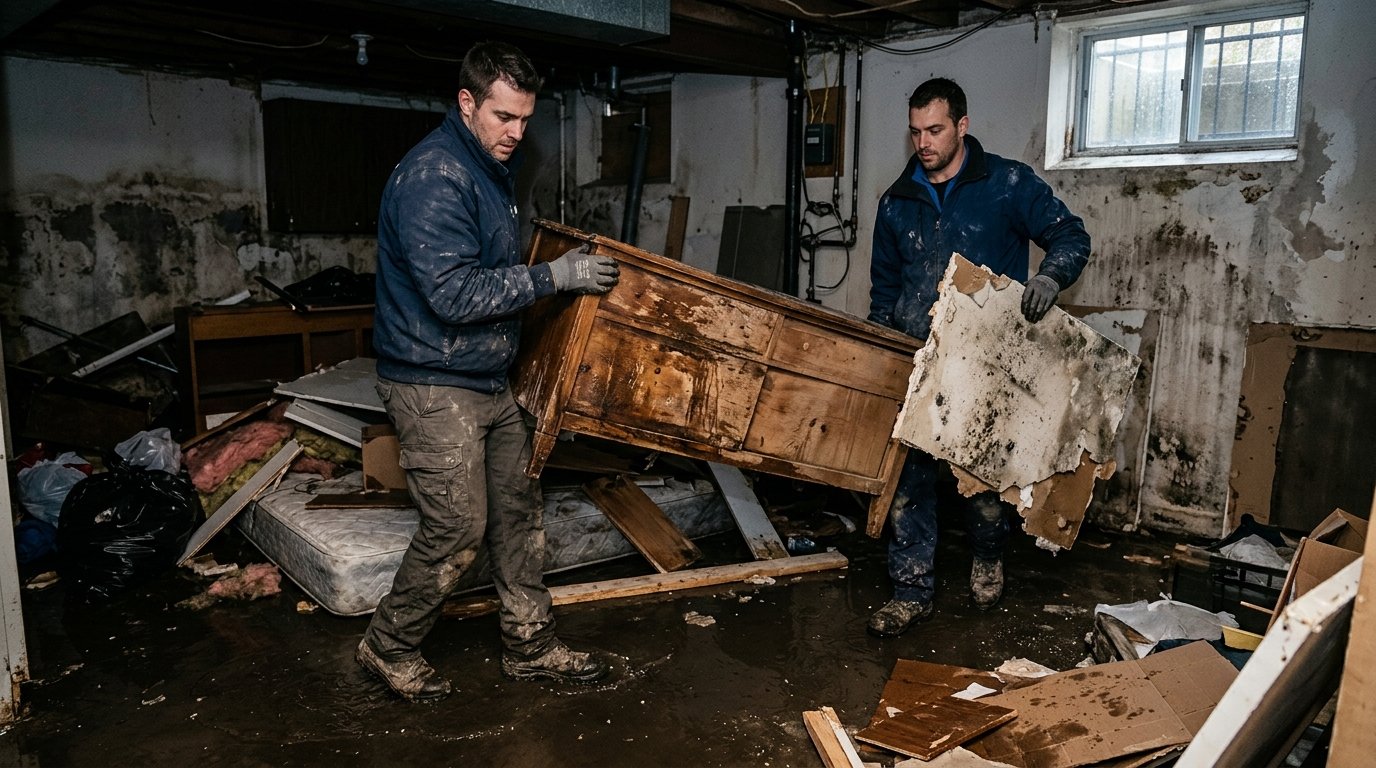
Nobody plans for a sinistre. One minute you're living a normal week in your Rosemont duplex or your Chomedey condo, and the next you're standing in two inches of water from a supply line that let go behind the dishwasher, or you're staring at a scorched kitchen wall after a stovetop fire got out of hand. The damage itself is only half the problem. What happens in the following 24 to 48 hours determines whether you're dealing with a contained cleanup or a much bigger, much more expensive mold and structural remediation project.
Standing water and soaked porous materials — carpet, drywall, insulation, particleboard furniture, cardboard boxes — start supporting visible mold growth in as little as 24 to 48 hours in a warm, humid Montreal summer, and not much longer than that in winter once the heat is running and condensation sets in behind wet baseboards. Every day that saturated material sits in your home, the spore count climbs, the smell gets worse, and the odds that a contractor will need to cut further into your drywall or subfloor go up. Fire damage adds a second layer: soot is acidic and keeps etching into surfaces the longer it sits, and the water used to put the fire out often causes as much secondary damage as the flames did.
That's the entire logic behind an emergency cleanout service. We're not firefighters and we're not a remediation company that runs air scrubbers and dehumidifiers — we are the crew that physically removes the ruined, unsalvageable, and safety-hazard material fast enough that the drying-out and rebuilding process can actually start. In a lot of cases we're working the same week as a remediation company or a general contractor, clearing the way for their equipment.
If you've lived here a while, you've probably heard of it happening to a neighbor even if it hasn't happened to you yet. Montreal's housing stock is old by North American standards — plenty of triplexes and duplexes going back 70, 80, even 100+ years — and that history shows up directly in why water damage and fire calls are so common.
None of this is meant to alarm you — it's context for why we built emergency response into our regular service lineup rather than treating it as a rare add-on. It isn't rare here.
The first sixty minutes after you discover water damage or get cleared to re-enter after a fire matter more than almost anything that happens afterward. Here's the order we tell people to follow, whether you end up calling us or not:
Soaked carpet and underpad, waterlogged furniture, ruined mattresses, wet drywall offcuts and insulation once removed from the wall, damaged boxes and belongings.
Charred furniture and cabinetry, soot-damaged belongings, melted appliances, burnt building material, and the water-damaged items around the fire zone.
A dedicated crew and truck that can be on-site within 24-48h, working around your insurer, your contractor, or your building's elevator booking window.
A typical emergency call starts the same way: you describe what happened, roughly how much space is affected (a bathroom, a basement, a whole main floor), and whether an insurance claim is already open. We give you a price range on the spot, and if it's a real emergency — active leak stopped but material sitting in standing water, or a fire inspector has already cleared the unit for entry — we prioritize getting a truck to you within the 24-48h window rather than the standard scheduling queue we use for a routine residential cleanout.
Insurance adjusters and restoration contractors talk about water damage in three categories, and it's worth knowing which one you're in because it changes what's worth trying to save.
Category 1 — clean water. A supply line, a dishwasher hose, an overflowing sink. If the water is caught and dried within 24 hours, hard surfaces (tile, sealed hardwood, metal furniture frames, plastic totes) are usually fine once wiped down and dried. Anything porous that sat in it for more than a day — a rug, a cardboard box of documents, an upholstered chair — is a coin flip and usually not worth the risk once mildew smell shows up.
Category 2 — grey water. Washing machine overflow, dishwasher backup, water that's picked up some contamination. The threshold for discarding porous material drops here. Carpet, carpet pad, and particleboard furniture that sat in grey water should come out, full stop.
Category 3 — black water. Sewer backup, ground flooding, or water that sat long enough to become contaminated. Everything porous that touched it needs to go, and we treat this material the same way we'd treat any biohazard-adjacent debris — bagged, handled separately, and disposed of through the correct channel rather than mixed with regular donation-eligible items.
In practice, on a typical Montreal basement flood call, here's what we see thrown out versus kept:
Solid wood furniture (dried fast), metal shelving, sealed plastic totes, tile flooring, hard toys, non-porous décor, appliances that never got fully submerged.
Mattresses and box springs, upholstered sofas and chairs, carpet and underpad, particleboard/MDF furniture, cardboard boxes, drywall and insulation once cut, insulation-backed ceiling tiles.
If a mattress got wet, don't try to dry it out and reuse it — see our dedicated guide on mattress and box spring disposal in Montreal for the safe way to get rid of one, whether or not it's flood-related.
Fires get most of the attention, but the water used to extinguish them is often what does the most cleanup work. A kitchen fire that stayed contained to a stovetop and cabinet can still leave the entire main floor soaked from a fire extinguisher or hose line, on top of the actual burn damage. That means a fire cleanout is almost always a combined job: charred, unsalvageable structural and furniture debris, plus water damage exactly like the flood scenarios above, plus a soot layer that settles on everything in the unit — including rooms that never saw flame.
A few practical notes from doing this work in Montreal triplexes and duplexes, where a fire in one unit routinely affects the ones above and below through shared walls and ductwork:
If a fire inspector or your insurer has already cleared the unit for re-entry, we can usually mobilize within the 24-48h window. If the unit hasn't been cleared yet, we'll ask — we won't send a crew into a space that fire services or an inspector hasn't signed off on, for the crew's safety and yours.
The single most common question we get on an emergency call is some version of "should I wait for the adjuster before you touch anything?" Here's the honest answer, based on how Quebec insurers typically handle these files:
We are not a public adjuster and we don't assess claim value — that's between you and your insurer. What we do is move fast enough that your mitigation timeline stays on track, and give you clean paperwork to support the claim.
| Scope | Example | Price range |
|---|---|---|
| Single room | Bathroom, small bedroom, kitchen after a leak | 300$ – 600$ |
| Multiple rooms / basement | Flooded basement, main-floor fire and water damage | 700$ – 1400$ |
| Full unit | Full apartment or house post-flood or post-fire cleanout | 1500$ – 3000$+ |
Prices depend on real volume, access (walk-up, elevator booking, ruelle access), and whether material needs special handling (contaminated water, biohazard-adjacent debris). We confirm the range by phone before dispatching and stand by it on-site.
Tell us what happened, roughly how much space, and whether it's an active hazard. We flag genuine emergencies for priority scheduling.
We walk you through what to photograph for your insurer, and confirm a price range before the truck leaves our yard.
We remove damaged material safely, separating anything that needs special disposal handling from general debris.
You get a receipt for your insurer, and your unit is ready for drying equipment, a contractor, or remediation crew to start.
Sinistres don't wait for convenient traffic, so we run emergency response across Montreal and the surrounding area, including Côte-des-Neiges–NDG, Rosemont, Le Sud-Ouest, Villeray–Saint-Michel, Hochelaga-Mercier, and over to Chomedey in Laval and the West Island via DDO. See our full list of service areas if you don't see your neighborhood here — chances are we still cover it.
For rental buildings and condos, we routinely coordinate directly with property managers and syndicates as well as tenants, since a burst pipe or fire in one unit often means access windows, elevator bookings, and shared-hallway protection need to be worked out before a truck even arrives. If your building has a commercial component — a mixed-use building with ground-floor retail, for instance — we handle that side of the cleanout too.
When you're standing in a flooded basement at 9pm, you don't have time to shop around carefully, so here's a quick, factual comparison to help you decide who to call.
Published price ranges upfront, 24-48h emergency priority, local crew that knows Montreal building access (walk-ups, ruelles, elevator booking), sorts for donation/recycling before landfill.
National franchise network with broad availability, but pricing is quoted on-site rather than published, so you're negotiating a number without a reference range in hand.
Known local name in Montreal searches. Ask directly about emergency response times and water or fire damage handling before you book, since details are not always posted online.
Our take: for a genuine sinistre, what matters most is a real person picking up the phone, an honest price range before the truck shows up, and a crew that shows up when they say they will. That's the bar we hold ourselves to on every emergency call.
Sometimes, yes — and we'll tell you that honestly on the phone rather than push a truck you don't need. If it's a single small area, clean water, caught within a few hours, and you have somewhere to haul a few soaked items yourself, a DIY cleanup is completely reasonable. Here's a realistic breakdown of when it makes sense to call versus handle it yourself.
A single wet area under 50 sq ft, clean-water source, caught within hours, no more than one or two items to discard, and you have vehicle access to a municipal ecocentre for disposal.
Multiple rooms or a full basement, grey or black water involved, heavy soaked furniture or a mattress, fire debris of any kind, tight timeline for insurance or a sale, or no vehicle/time to run multiple ecocentre trips.
The math that usually tips people toward calling a crew isn't really about whether they're physically capable of hauling a wet rug to the curb — it's about time. A soaked queen mattress alone weighs 60-90 lbs wet, most personal vehicles can't fit a full soaked sofa, and Montreal's ecocentres have limited hours and often a per-visit volume cap. What looks like "just a weekend project" frequently turns into three or four separate trips stretched across a week you don't have, while the clock on mold growth keeps running the whole time.
A sinistre sometimes forces a move you weren't planning, or turns into a chance to finally deal with belongings you'd been putting off. If that's you, our guides on what to do with unwanted furniture and belongings when moving in Montreal and decluttering and minimalism, where to start in Montreal walk through the practical next steps once the emergency phase is behind you.
For genuine emergencies we aim for 24-48 hours from your first call, and often same-day if your schedule and our route allow it. Call us and describe the situation so we can prioritize accordingly.
Photograph and document everything first, but do not wait on damaged, wet, or charred items that pose mold or safety risks. Most insurers accept dated photos and a written inventory as proof of loss, and we can help you build that record before we haul anything away.
Most single rooms run 300$-600$, a full basement or several rooms of soaked or fire-damaged material runs 700$-1400$, and a full-unit post-disaster cleanout is typically 1500$-3000$+ depending on volume and access.
We remove mold-affected furniture, drywall offcuts, insulation, and porous debris once it has been cut out or bagged by you, your contractor, or a remediation company. We are a hauling and disposal service, not a mold remediation or air-quality contractor.
Hard, non-porous items wiped down within 24-48 hours are usually salvageable. Porous items soaked for more than 24-48 hours — mattresses, upholstered furniture, carpet, drywall, particleboard — almost always need to be discarded because they trap moisture and grow mold from the inside out.
Yes. We regularly work with landlords, property managers, and condo syndicates after a burst pipe or fire, coordinating access with tenants and building management and working around elevator booking windows in larger buildings.
Planning a pickup? See all of our service areas, including Kirkland and Beaconsfield. Related reading: Basement Cleanout in Montreal: The Complete Before/After Guide and Condo Cleanout in Montreal: Access Challenges and Solutions.
Call us now or send details through our contact form. We'll give you an honest price range and a realistic timeline within the 24-48h window.
📞 (514) 295-2123From $150, same-day pickup often available in Montreal, Laval, the North Shore and the South Shore.
GoodBye Junk Montréal
Montreal, QC, Canada
Call nowFree quoteBook onlineAbout us